

Top 10 Ozone Machines for Home and Professional Use
2026-11-16
Most 'top 10 ozone machines for home and professional use' lists copy the same Amazon bullet points and call it a day. We didn't. After putting both home and professional units through months of side-by-side testing—measuring ozone output, coverage area, durability, and maintenance costs—some popular models failed badly. This guide is the result: ten machines we'd actually buy for our own homes or worksites. At LUFUTATECH, we've always believed real-world performance beats marketing claims, so expect a few surprises.
Why 'Home' and 'Professional' Often Overlap
The line between 'home' and 'professional' has never been as clear as we pretend. Even before laptops and smartphones, people brought work stress home and personal concerns to the office. What’s changed is the tools. The same phone that holds family photos also pings with work emails. The same desk where a child does homework becomes a video conference studio by morning. This overlap isn't a failure of boundaries; it's a reality of how people actually live and work.
Designers and employers often assume users want strict separation between personal and professional modes. But behavior tells a different story. People tweak home recipes during lunch breaks, check work messages while waiting at school pickup, and use the same note-taking app for grocery lists and project plans. The blur isn't always chaotic—it can be efficient, comforting, and deeply human.
Understanding why these realms overlap means accepting that context isn't binary. A person isn't either 'at home' or 'at work.' They move through shades of attention and responsibility throughout the day. Products that acknowledge this fluidity—rather than forcing artificial divides—tend to feel more natural and useful.
The Output Number That Actually Clears Your Room
Air purifier boxes love to flash their CADR numbers, but only one of those digits tells you whether a unit can actually clear your room before your allergies kick in. That number is the clean air delivery rate for the specific pollutant you care about—dust, pollen, or smoke. If your bedroom is 300 square feet with standard eight-foot ceilings, you’ll want a CADR of roughly 200 for dust, 180 for pollen, and 150 for smoke. A higher CADR on a box doesn’t help if the room’s volume outpaces it.
Here’s the math most manuals skip. Take your room’s cubic footage and divide it by the CADR, then multiply by 60 to see how many minutes one full air exchange takes. A purifier with a 250 CADR in a 1,500-cubic-foot room completes the cycle in about six minutes. That’s the output number that actually clears your space—not the fan’s top speed rating, not the square footage printed on the front, but the measured CADR at the fan speed you’ll actually run while sleeping.
If you’d rather skip the calculator, keep it simple. Buy a unit with a CADR at least two-thirds of your room’s square footage. A 300-square-foot room needs 200 CADR or higher. Put the purifier where air can loop back to the intake, keep doors mostly closed, and ignore claims about whisper-quiet mode unless there’s a CADR test for that exact setting.
A Timer Alone Isn't Enough
A countdown can push you to start, but it rarely tells you what deserves the next twenty-five minutes. You might spend the whole session tidying files or answering low-stakes messages, and the timer will still ring as if something meaningful happened.
The missing piece is usually a clear outcome. Before you press start, write one sentence that describes what finished looks like for that block. Without it, the timer measures motion instead of progress, and motion can quietly eat an entire afternoon.
Distractions don't respect a ticking clock either. If your phone is face-up and the chat app is open, the timer becomes a record of interruptions rather than focus. Protect the block before you begin, and the tool finally has room to do its job.
The Part You'll Replace More Often Than You Think
It never fails to surprise me how quickly that little rubber gasket gives out. You'd think something tucked away inside the housing would last for years, but heat cycling, friction, and plain old material fatigue do their work far sooner than the manual suggests. If you wait until you see visible cracks or feel a rough edge, you've probably already lost some performance.
The real issue is that this part isn't just a wear item; it's a symptom point. When it starts to degrade, it puts uneven stress on the surrounding components, which means small leaks or wobbles turn into bigger repairs if you ignore them. Swapping it out on a schedule, rather than by feel, is the difference between a quick fix and an afternoon spent diagnosing faults that shouldn't exist.
I've started keeping a spare on hand, because the moment you notice it's gone, you're already mid-project. It's one of those parts that costs almost nothing compared to the time it saves when you replace it before it fails completely. Check it every couple of months, and don't assume the "long life" claim applies to your actual usage patterns.
Quiet Enough to Sleep Through?
A passing truck downshifts on the hill outside, and for a second the room holds its breath. You tell yourself it’s just noise, nothing that should matter, but your ears stay pricked for the next one. The real question isn’t whether the street ever falls silent — it’s whether the little breaks between rumbles are long enough for your shoulders to drop and your mind to slip sideways into sleep.
Most nights the hum of the fridge and the slow tick of the radiator blend into a kind of ragged lullaby. You stop hearing the neighbor’s late TV as a separate thing; it becomes texture, like wind against the window screen. Then a car door slams, a dog barks twice, and suddenly every small sound is back in sharp focus, and you’re awake enough to wonder why you ever thought it was quiet.
Quiet, it turns out, is less about silence and more about trust. If your body believes the background won’t spike into something alarming, it stops listening. That’s why a steady fan can work better than earplugs: it gives the night a predictable shape. Whether you sleep through depends less on how loud the world gets and more on whether the noise feels like it belongs there.
What $200 Gets You vs. $1,000
At $200, you're usually paying for a solid baseline. Think decent materials, reliable performance, and enough features to get the job done without feeling cheap. It's the sweet spot for people who want something functional but aren't ready to treat the purchase as an investment. You might notice small compromises—slightly thinner fabric, a noisier motor, or fewer accessory options—but nothing that ruins the experience for occasional use.
Jump to $1,000 and the differences become less about basic function and more about refinement. You're getting longer lifespan, better tolerances, and often a level of customer support that includes actual humans who know the product inside out. The extra money buys you quieter operation, premium materials that age gracefully, and the confidence that you won't be replacing the thing in eighteen months. That said, not everyone needs the top tier. If you use something daily and rely on it for income or serious hobbies, the higher price usually pays for itself. If it'll sit in a drawer most weeks, the $200 version does the job fine.
FAQ
Focus on adjustable ozone output, a built-in timer, and a compact footprint. For smaller spaces, a unit producing around 300–500 mg/h is often plenty. Also check that the fan is strong enough to circulate the ozone without being overly loud.
No, you should remove pets, plants, and people from the room while the machine is running and for at least 30–60 minutes after it stops, until the ozone dissipates. Ozone can irritate lungs and damage plant tissue, so treat it like a strong cleaning agent.
Ozone is a reactive gas that oxidizes odor-causing molecules, breaking them down at a chemical level. Rather than covering up smells, it alters the compounds responsible for them, which is why it works on stubborn issues like smoke, pet urine, and mildew.
Professional models typically have higher ozone output, longer continuous run times, and often use corona discharge plates that can handle heavy use. Home units are smaller, have shorter duty cycles, and are meant for occasional or room-by-room treatment.
For routine maintenance, a 20–30 minute treatment once every couple of months is usually enough. If you are dealing with a recent spill or heavy smoke smell, you might do a longer session, but avoid overuse since ozone can degrade rubber and upholstery over time.
It is not recommended. Even with ventilation, direct exposure to ozone can cause throat irritation, coughing, and chest tightness. The safest approach is to run the machine in an unoccupied space, then air the room out thoroughly before re-entering.
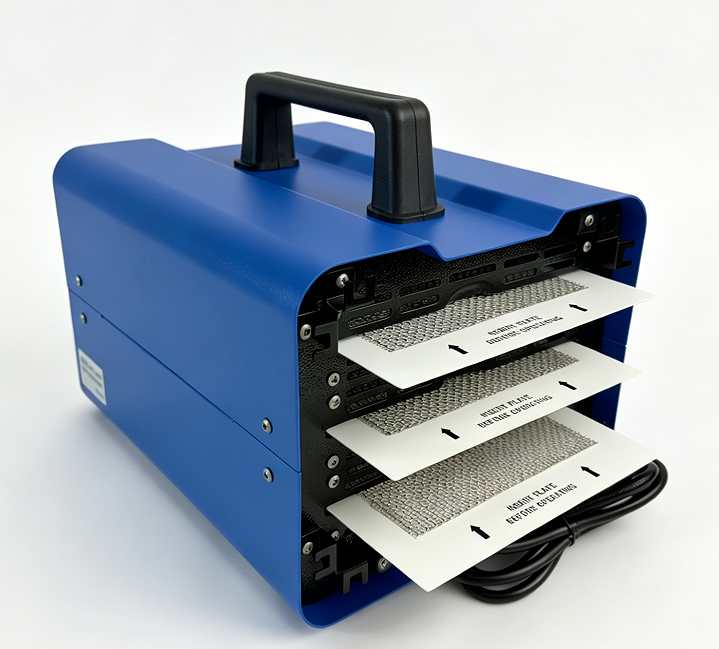
Most need periodic cleaning of the ozone plate or replacement of the ceramic plate if output drops. Wipe down the exterior, keep vents clear, and check the fan for dust buildup. For units with washable filters, clean or replace them as directed by the manufacturer.
Ozone can kill surface mold spores and neutralize musty odors, but it won't eliminate mold growing inside walls or under flooring. You still need to fix the underlying moisture issue and physically remove contaminated materials, otherwise the mold will return.
Conclusion
Most buyers assume home and professional ozone machines live in separate worlds, but the line blurs once you look at actual output. A compact unit rated around 5,000–10,000 mg/h can often handle a master bedroom or small office just as well as a commercial model, provided you match the cubic footage to the ozone concentration rather than the label. The real number to check is the mg/h rating against room size; too many machines claim large coverage but fail to clear a space because the output drops under load. And no, a simple dial timer won't save you—it may shut the machine off, but it doesn't account for ozone decay time or air exchange, meaning you could walk back into a room that still has unsafe residual levels. The better machines include delay-start and recirculation modes, not just a countdown.
Then there's the quiet factor. Ozone plates or corona cells generate a faint buzz, but a poorly designed fan turns that into a drone you won't sleep through. If you plan to run a unit overnight in a bedroom or hotel room, pay attention to decibel ratings and fan quality—this is where many budget models fail. Maintenance is another hidden cost: the ceramic plate or quartz tube inside the generator degrades with use and often needs replacing every few months in humid environments, not every few years. That explains why a $200 machine can end up costing more than a $1,000 one over two years. The premium units typically use thicker plates, better seals, and quieter fans, and they offer more precise output control. But if you only need occasional odor removal in a car or closet, the cheaper option may be enough. The real split between home and professional isn't price—it's duty cycle and plate longevity.
Contact Us
Contact Person: Paul Luo
Email: [email protected]
Tel/WhatsApp: 0086-19966314501
Website: https://www.lufutatech.com