

Spring Energized PTFE Seal Factory Practices That Deliver Consistent Performance
2026-11-18
Spring energized PTFE seals often look interchangeable on a datasheet, but their performance tells a different story once temperature, pressure, and chemical exposure start to climb. The difference is rarely the design alone—it is the discipline behind the factory process. At TAIFNO, consistent seal performance is treated as an engineering outcome rather than a batch-by-batch hope. From material handling and machining control to spring loading and final inspection, each step is calibrated to remove the small variations that eventually show up in the field. This article looks at the practices that separate dependable seals from costly surprises.
Raw PTFE Selection That Starts With the Operating Temperature
Letting the operating temperature lead the selection process quickly separates realistic PTFE options from grades that will not survive. Unfilled PTFE generally handles continuous service from roughly -200°C to 260°C, with brief excursions above that possible but increasingly risky as the material approaches 400°C and begins to release decomposition byproducts. When the expected temperature sits near either end of that range, dimensional movement, creep, and outgassing deserve more attention than the raw temperature rating printed on a datasheet.
The actual working temperature also determines whether an unfilled resin is sufficient or whether a filled compound becomes necessary. In hot, load-bearing applications, glass, carbon, or bronze fillers can reduce cold flow and thermal expansion, but they often change chemical compatibility and surface hardness. At very low temperatures, many seals and bearings perform better with pure PTFE because some fillers stiffen the material and make it less forgiving when parts shrink or flex.
It is useful to treat the operating temperature as the first filter rather than the final answer. Heat aging behavior, thermal cycling, frictional heat buildup, and whether the component sits under load can shift the practical limit well below the published maximum. A material that survives a static oven test at 260°C may fail in rubbing contact at 180°C, so temperature should be paired with the mechanical and chemical conditions of the actual assembly before a grade is locked in.
Tooling Decisions Behind a Crisp, Repeatable Seal Lip
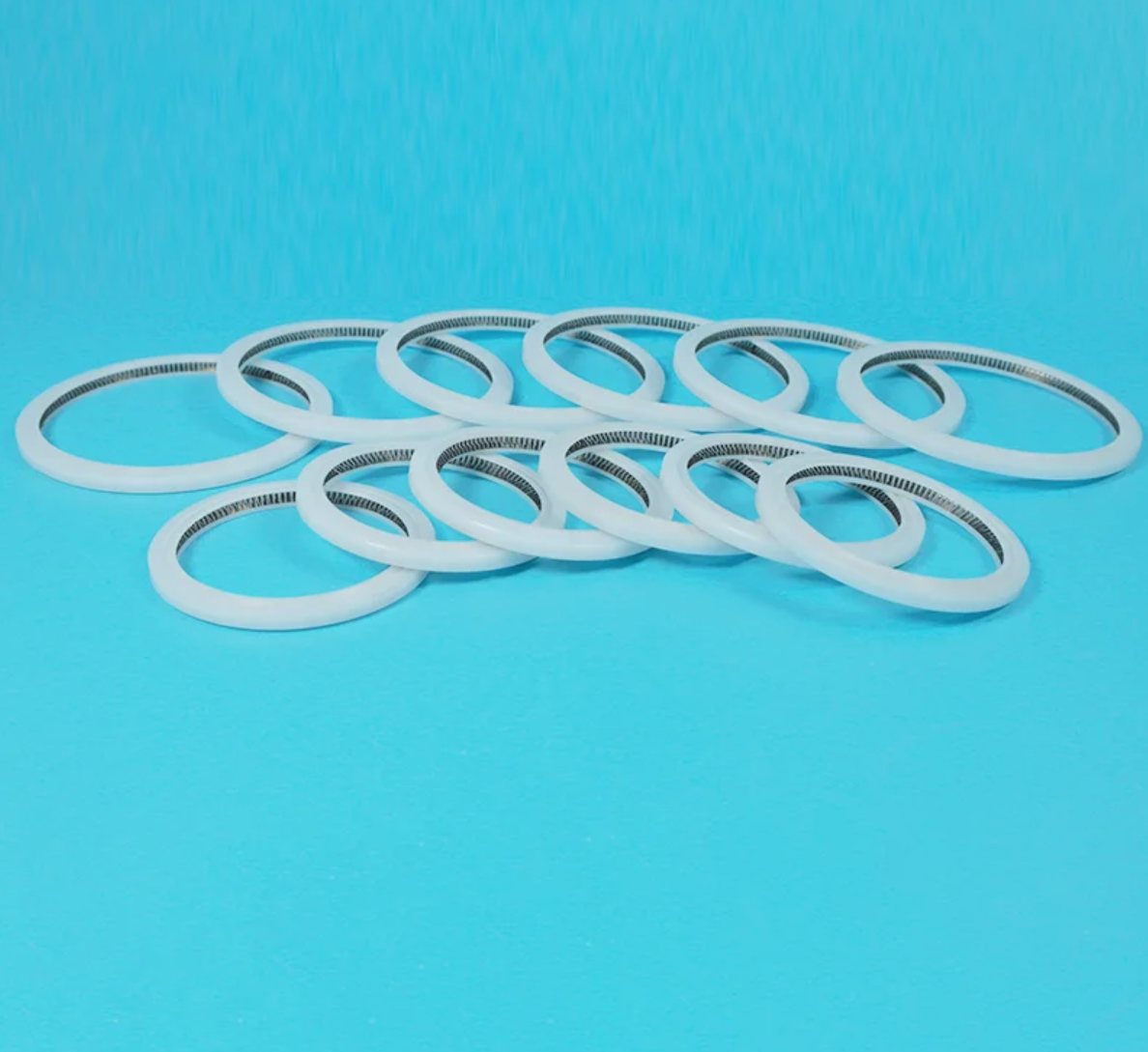
A repeatable lip starts with the shutoff. Rather than trying to split the lip across two steel faces, the tools that hold dimension cut the entire lip profile into one insert and leave the parting line on a non-critical shoulder. The edge itself gets a near-zero land, then a fine stone finish across the shutoff so the rubber tears clean instead of peeling into a feathered flash. Without that, no amount of trimming really brings the contact edge back.
Fill path is the next lever. When the material front hits the lip from the side, it can fold and leave a visible knit line exactly where sealing happens. Moving the gate slightly lower and adding a narrow vent at the lip tip lets the air escape before the front stalls. The result is an edge that cures sharp and full, without the rounded, underfilled look that comes from trapped gas or excessive pressure loss.
Ejection has to be just as deliberate. A lip that is stripped or pried out will quickly lose its geometry. Good tooling supports the part from a thicker section and releases the lip with a plate lift rather than a pin push. Designing the lip as a replaceable insert also means the edge can be reconditioned when it starts to round, which keeps later parts closer to the original sample than re-polishing the entire cavity ever could.
Spring Coil Inspection Under Load, Not Just on Paper
A spring coil that looks right on a spec sheet can still behave unexpectedly once force is applied. Free-length measurements, coil diameter, and pitch values only describe the part before it starts working. Real inspection under load watches the coil stack change shape: end coils seat against adjacent turns, active coils shift their spacing, and the load line drifts from the calculated curve in ways that static checks miss.
On the test bench, the spring is compressed to a fixed working height or a target force while cameras, dial indicators, or strain gauges record what the wire actually does. The most revealing moments are rarely at full compression. Mid-stroke coil contact, uneven side-to-side gap reduction, or a coil that touches earlier on one flank than the other point to problems in coiling, heat treatment, or shot peening that no drawing review would catch.
Comparing loaded and unloaded profiles also uncovers fatigue risks before a single cycle is logged. A dull area on the inner diameter that opens into a fine crack under tensile stress, or a slight kink near the pitch transition that only appears at 70 percent of solid height, tells you more about service life than a checklist of dimensional tolerances. Using those loaded-state observations to adjust end coil geometry or pre-setting practice usually saves more warranty cost than another round of blueprint verification.
Contamination Control for Flawless Seal Surfaces
A seal surface can look clean under normal light and still fail the moment pressure is applied. Dust, metal fines, skin oils, and even dried cleaning fluid leave behind a film or particle that prevents full face-to-face contact. Rather than treating cleaning as a final touch, it works better to treat every handling step as a contamination risk. That means keeping seal faces covered until installation, using tools that do not shed fibers, and questioning whether gloves are actually clean or just worn for appearance.
The most useful controls are often the least complicated. Remove protective packaging only when the part is ready to be installed, not when it first arrives at the workstation. Use lint-free wipes and a solvent that leaves no residue, then dry the surface immediately so moisture does not attract airborne dust. A quick inspection with a light held at a low angle can reveal haze, smears, or fine particles that a straight-on view misses.
It also helps to build habits around what should not happen. Bare fingers should never touch a lapped or polished seal face, and parts waiting for assembly should stay under a clean cover instead of sitting open to shop air. When a leak does occur, trace it back to the last point of contact rather than assuming the seal itself was defective. Often the root cause is a dirty glove, a contaminated assembly bench, or a cleaning step that left more behind than it removed.
Testing Seals at the Edge of Their Pressure Rating
Seals are typically assigned a pressure rating based on standardized test conditions, but real-world systems rarely behave with that kind of predictability. Pushing a seal toward the upper limit of its rating often exposes failure modes that are less about material strength and more about how the seal interacts with hardware tolerances, temperature swings, and pressure spikes. A seal that performs flawlessly at 80% of its rated pressure can begin to extrude, chatter, or leak at 95% because the gap it must bridge changes under load. This is why testing at the edge is not an exercise in finding the breaking point; it is about mapping where confidence starts to erode.
One of the most overlooked variables in edge testing is time at pressure. Short-duration burst tests can give a false sense of margin because viscoelastic materials recover quickly once the load is removed. But hold a seal near its rated limit for hours, and small deformations accumulate. The lip that initially held back fluid may start to fold or develop a micro-leak path that grows in tiny increments. Thermal cycling during this hold makes it worse, as the elastomer expands and contracts against a housing that does not move at the same rate. A pressure rating, in that sense, is not a fixed threshold but a band where the seal’s long-term stability becomes questionable.
Practical edge testing therefore shifts focus from pass/fail to degradation curves. Instead of asking whether the seal survives a single excursion, operators log leakage rates, extrusion depth, and friction changes across repeated cycles near the rating. That data reveals whether the seal is settling into a stable deformed state or heading toward sudden failure. It also informs installation guidance, because a seal run at 98% of its rating in a lab still has to contend with field misalignment and contaminated fluid. Understanding that margin is smaller than the datasheet suggests is the real value of testing at the edge.
Lot Traceability That Links Every Seal to Its Test Record
Every seal that leaves our production line carries more than just a part number. We tie each individual unit back to the exact raw material batch, the specific molding machine used, the operator on shift, and the precise moment it passed through curing. That link stays unbroken from the first inspection all the way to a searchable test record, so when a question comes up months later, you are not digging through stacks of paper or guessing which lot it belonged to.
The traceability starts at incoming rubber compound and follows it through mixing, preforming, molding, post-curing, and final QC. A serialized code on the seal or its packaging opens the full history: dimensional checks, compression set values, hardness readings, and any visual or functional test result. If one machine drifts out of spec, we can instantly identify every affected seal and pull only those units instead of issuing a broad recall.
For engineers and quality managers, this means audit-ready documentation without the busywork. You can see exactly what was tested, when it was tested, and which seals share the same production conditions. That level of clarity turns traceability from a compliance checkbox into a practical tool for root cause analysis, supplier confidence, and long-term field performance tracking.
FAQ
A spring energized PTFE seal uses a machined PTFE jacket with a corrosion-resistant spring inside that keeps the lip in contact with the shaft or bore as the polymer wears or temperatures shift. A standard lip seal usually relies on an elastomer's own tension and is far more limited in chemical and thermal range.
Virgin PTFE works well for the widest chemical compatibility, but for wear resistance and extrusion resistance many shops use modified PTFE with controlled fillers such as glass, carbon, graphite, or minerals. The filler package has to be selected carefully because too much filler can make the lip brittle or raise leak paths.
The cavity is usually CNC turned with sharp, low-friction tooling and a controlled feed to avoid tearing the PTFE surface. Machinists break sharp edges, hold radii at the bottom corners, and verify groove width and depth in-process so the spring sits consistently instead of tilting or bunching.
Good shops inspect the lip under magnification for nicks or fuzz, measure key seat dimensions on a CMM or optical comparator, run a spring load check at working height, and leak test the seal with low-pressure air or nitrogen. Surface finish on the dynamic lip is also checked because a rough lip can wear the hardware quickly.
The lip contact pressure is set by the spring force at its installed working height, not by the free length of the spring. A small change in spring rate or formed angle can change that contact load enough to cause either leakage from under-loading or rapid wear from over-loading, so most factories set a narrow load window rather than only checking geometry.
Yes, many facilities stress-relieve or anneal PTFE blanks before or after roughing to stabilize the material and reduce movement during final cuts. The temperature and soak time have to stay below the point where the material starts to degrade or lose its shape, so the process is usually tied to the specific grade and part size.
It can, but the design has to include the right lip orientation, controlled spring cavity depth, and often a backup or anti-extrusion feature for the PTFE jacket. Testing with nitrogen or helium against a known finish and hardware gap is common because gas service is far less forgiving than liquid service.
Ask for raw material certifications, first article dimensional reports, spring load curves, lot traceability, leak test data, and a clear process change notification policy. These records give a much better picture of consistency than a generic certificate of conformance alone.
Conclusion
Consistency in spring energized PTFE seals starts long before the first part comes off the line. Material selection gets pinned to the actual service temperature window, not a generic PTFE grade, so the jacket behaves predictably at both low-temperature start-up and elevated soak conditions. Tooling is then built around the lip geometry rather than forcing a standard cavity to work; small adjustments in land length and entry angle are what keep the seal lip crisp and repeatable from cavity to cavity. Spring coils are not accepted on certificate alone. Each batch is compressed to working height and inspected under load, because a spring that looks fine on paper can still take a set or lose recovery once installed.
The same discipline carries through assembly and final release. Cleanroom-style handling and lint-free wiping keep mating surfaces and seal lips free of embedded particles that would otherwise create a leak path. Before shipment, seals are not simply checked at nominal conditions; they are taken to the upper end of their pressure rating and held there long enough to expose any tendency to extrude or relax. Every seal also carries a lot number that links back to its raw PTFE lot, spring coil batch, inspection notes, and pressure test record. That traceability closes the loop, so a field return or a borderline result can be investigated against the exact conditions that produced the part.
Contact Us
Contact Person: Tommy Xiao
Email: [email protected]
Tel/WhatsApp: 8615651509888
Website: https://www.ptfe-factory.com