

Industrial HVLS Fans Company Insights: Choosing the Right High-Volume Low-Speed Fans for Large Facilities
2026-11-16
Managing a massive warehouse or production floor quickly reveals how ordinary fans fall short. Stagnant air, uncomfortable hotspots, and soaring energy bills are all too common. That’s where high-volume low-speed (HVLS) fans come in—but choosing the right one for your facility isn’t just about blade size. VINDUSFAN has been addressing these challenges with tailored solutions, and in this guide, we’ll unpack what really matters when selecting HVLS fans for large spaces.
Mapping Your Facility's Airflow Before You Buy
Walk through each zone with a simple smoke pencil or incense stick—watch how air curls around corners, stalls behind shelving, or slips out loading docks before treatment begins. Mark these paths on a basic floor plan, not as a formal diagram but as working notes. You'll likely find that the spots with the least movement are the same ones where odors, dust, or humidity linger longest. This low-tech pass often reveals more than a spec sheet ever will.
Pay attention to how the building breathes at different times. A facility that seems well-balanced at noon can turn into a dead-air box at 5 a.m. when ventilation throttles back. Note where doors open most often, where equipment generates heat, and where exhaust fans pull negative pressure. These aren't abstract concerns; they change the size and placement of any system you bring in.
Use the map to challenge assumptions. If the sales conversation starts with square footage and ends with a model number, you haven't actually mapped airflow—you've just measured the floor. Instead, let the observed patterns drive the conversation toward specific, site-based details, like the east mezzanine trapping warm air by mid-morning and needing something that can push across that rise. That kind of ground-level observation makes the purchase decision much harder to get wrong.
Blade Geometry That Actually Moves Air at Low Speed
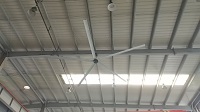
Most fan blades at low speed simply stir air instead of moving it. The real difference lies in the twist distribution and chord variation from root to tip. At low rotational speeds, the suction side is prone to laminar separation bubbles that crush efficiency. Moving the point of maximum camber forward to 25–30% of chord and using a thin airfoil around 8% relative thickness can delay separation significantly. A slightly reduced leading-edge radius also lowers sensitivity to angle-of-attack shifts, helping the blade maintain attached flow even at low rpm.
The tip region is another overlooked area. Low-speed rotation creates a relatively strong tip vortex, and if the blade is simply chopped off, that vortex rolls up and wastes energy. A swept-back tip or small winglets on the upper surface—along with a serrated trailing edge inspired by owl feathers—can break up the concentrated vortex and reduce induced drag. But these changes must match the overall solidity: too much solidity increases skin friction, while too little fails to build enough pressure difference, causing air to leak back from the high-pressure side to the low-pressure side.
Manufacturing tolerances matter more than most designers admit. Low-speed blades are extremely sensitive to surface roughness and leading-edge burrs; even a 0.1 mm step can trigger premature transition, turning what should be laminar flow into turbulent flow and quietly bleeding static pressure. That means parting lines from injection molding or CNC tool marks need to be accounted for in the design itself, not polished away as an afterthought. The goal is for every blade to create a stable radial pressure gradient at low rpm, forcing air to accelerate axially instead of circling between the blades.
The Real Cost of Running HVLS Fans Year-Round
Most facility managers look at the sticker price of an HVLS fan and assume the biggest expense is upfront. In reality, the true cost unfolds slowly, month after month, on the utility bill. A large-diameter fan can draw anywhere from a few hundred watts to over a kilowatt, and when it runs continuously through winter and summer, those numbers add up. The real cost isn't just the energy consumed—it's the missed opportunity to adjust the fan's speed, direction, or even turn it off during unoccupied hours. Many operators never realize that a fan spinning at full speed in an empty warehouse is quietly burning money that could have been saved with a simple schedule change.
Beyond electricity, there's wear and tear that often goes unnoticed until a bearing fails or a blade develops a crack. Running an HVLS fan year-round means the motor, gearbox, and mounting hardware are subjected to constant thermal cycling and vibration. Maintenance crews rarely budget for mid-life replacements, yet the cost of an unexpected shutdown—lost production time, emergency repair calls, and even damaged inventory from a falling component—can dwarf the annual energy expense. A fan that could last ten years with seasonal operation might need major service in five if it never gets a break.
Smart operators are now looking at the real cost from a different angle: what does the fan actually do for the space when it's running? In summer, the cooling effect can reduce air conditioning load, but in winter, running the fan in reverse to destratify warm air only pays off if the ceiling is high and the heat is well-insulated. For many buildings, the year-round fan is a comfort blanket that masks poor HVAC zoning or missing insulation. The real cost, then, is not simply the watts consumed but the lost chance to fix the root cause—and that's a price no one calculates until the annual budget review comes around.
Placement Patterns That Prevent Dead Zones
Most dead zones start with a router pushed against an exterior wall or buried inside a cabinet. A stronger pattern is to work from the geometric center of the space, but not in a rigid way. If the living room is off to one side, place the unit at the nearest open intersection between hallways or doorways rather than dead center. Keep it at least a meter away from metal shelves, large mirrors, and water pipes. Raising it to shoulder height or above a bookcase reduces interference from low furniture and moving bodies, which tend to absorb signal at floor level.
Reflections play a bigger role than most placement guides admit. A bare wall can bounce a signal around a corner, but a marble countertop or a stainless steel fridge turns that same reflection into destructive noise. If you need to cover an L-shaped apartment, try placing the router along the long axis rather than in the short leg. Let one antenna tilt slightly away from vertical to create a more oval coverage pattern. Test near the sharpest corner and shift the unit by only twenty or thirty centimeters at a time. Small adjustments near reflective surfaces often change the dead zone more than raising transmit power.
For multi-node setups, avoid lining up access points like beads on a string. A staggered triangle or diamond pattern works better because each node fills the shadow left by the other two. Keep inter-node distance under two interior walls and vary their heights slightly. One node on a bookshelf, another on a cabinet, and a third mounted high in a hallway will overlap without fighting each other. The kitchen and bathroom remain the hardest spots, so instead of boosting the main router, add a compact node just inside the doorway where tile and moisture cause the least reflection loss.
Smarter Controls for Changing Warehouse Conditions
Warehouse environments rarely stay static. A shift in outside temperature can pull cold air through loading docks, while a sudden order spike forces pickers into zones that were quiet an hour earlier. Instead of relying on fixed settings, smarter controls pull data from door sensors, thermostats, and motion detectors to adjust air circulation, lighting levels, and conveyor routing on the fly.
The practical advantage shows up in day-to-day operations. When a freezer door stays open longer than usual, the system can boost refrigeration output only for that zone rather than cooling the entire floor. If a packing line backs up, downstream conveyors slow automatically to prevent jams. These micro-adjustments keep conditions stable without requiring supervisors to chase alarms or rewrite schedules.
Facilities can implement this incrementally. Adding wireless sensors to existing dock doors and pairing them with a small edge controller often costs far less than replacing the building management system. Teams see the payoff in lower energy bills, fewer product losses, and less time spent on reactive fixes.
Extending Fan Life in Dusty or Humid Environments
Dust shortens fan life in ways that aren't always obvious. Fine particles work their way into bearing grease, turning lubrication into grinding paste while also coating blades and motor windings to reduce heat dissipation. A more effective approach is to install a filter with a differential pressure gauge on the intake side. Replace the filter only when the pressure drop exceeds the fan manufacturer's recommended limit—this prevents both clogging and the airflow loss that comes from using an overly dense media. Around the bearing area, a labyrinth seal or a low-pressure air purge can keep abrasive dust out of the lubricant far longer than periodic cleaning alone.
In humid environments, the real damage often occurs not during steady high humidity but when temperature swings cause condensation. After shutdown, internal surfaces cool below the dew point, and moisture collects on windings and bearing races, accelerating corrosion and insulation breakdown. Placing a small strip heater or dehumidifier near the fan can keep the local dew point below surface temperature. When shutdowns are unavoidable, running the fan at minimum speed on a timer for a few minutes every hour uses its own waste heat to drive off moisture before it settles.
Component selection matters more than most maintenance schedules. Choose fans with IP54 or higher enclosures and double-sealed deep-groove ball bearings instead of open or shielded types. Conformal coating on the PCB and gasketed connectors prevent moisture ingress at electrical interfaces. During routine inspections, pay close attention to blade balance and fastener corrosion—small rust spots on a hub can grow into imbalance that destroys bearings months later. Replacing a degraded coated part early is cheaper than dealing with an unexpected fan failure in the middle of a production run.
FAQ
Airflow reach and column placement matter more than blade count. Look for models with variable speed control and reversible modes; this helps direct air over racks without disturbing loose packaging. Also check motor placement and mounting height so the fan's downdraft doesn't create dead zones between aisles.
A large-diameter HVLS fan can move a broad volume of air at low speed, often replacing several smaller high-speed units. The result is lower total wattage per square foot, plus less noise and less draft on workers. Instead of blasting one spot, it gently circulates air throughout the entire space.
Blade diameter usually falls between 16 and 24 feet for that ceiling height. The key is keeping the fan high enough to avoid interference with cranes or lighting but low enough that the air column reaches the floor. Mounting at roughly one blade diameter above the occupied zone tends to work well.
Yes. In warm months, the airflow creates a cooling effect on skin and helps exhaust hot air when paired with ventilation. In winter, running the fan in reverse at low speed pushes warm air trapped near the ceiling down to the floor, reducing heating demand. Many facilities use that mode more than they expect.
Ask whether the fan mounts directly to steel beams or needs a support frame, whether the motor is sealed for dusty or humid environments, and how often bearings or belts need attention. Also confirm if the control system can integrate with existing building automation or VFDs, because that affects long-term ease of use.
Start with the total square footage and divide by the effective coverage area of a single fan, which depends on blade diameter and mounting height. Then adjust for obstructions like tall racking, columns, and loading docks. It is better to slightly overlap coverage zones than to leave stagnant areas near walls or workstations.
Warehouses, distribution centers, manufacturing plants, aircraft hangars, and agricultural buildings see the most gain. Any space with high ceilings and a large open footprint can benefit, especially if workers are spread out and traditional ductwork would be impractical or too expensive.
Focusing only on blade diameter or price and ignoring the motor's duty cycle and the fan's airfoil design. A cheaper fan may produce less airflow per watt or become noisy over time. It is also easy to overlook control options, which can make the difference between a fan that is used daily and one that gets switched off after a month.
Conclusion
A large facility rarely suffers from too much air movement; it suffers from air that never reaches the floor or the corners where people actually work. Before spending on any high-volume low-speed fan, walk the space with a simple smoke test or thermal mapping and note where heat, fumes, or humidity build up. The best blade designs for low-speed use aren't just longer versions of residential fans—they use airfoil profiles and tapered tips that push a wide, gentle column of air downward without creating noisy turbulence. This matters because a fan that merely stirs the upper air wastes electricity and leaves workers hot. The right geometry moves enough cubic feet per minute at a low rotational speed to feel like a steady breeze, not a wind tunnel, across a defined zone.
Running costs can surprise you if you only look at the motor nameplate. HVLS fans often run continuously, so even a small difference in efficiency adds up over a year. Compare actual wattage at typical speeds, not just peak horsepower. Placement is equally important: mount fans too far apart and you get dead zones; too close and the air columns collide and lose effectiveness. Use a grid pattern based on blade diameter and ceiling height, and keep at least one fan diameter of clearance from walls and racking. Modern controls pay for themselves in warehouses where doors open often or seasonal humidity shifts. Variable speed, temperature sensors, and reversing modes let you push warm air down in winter or increase airflow only when a zone is occupied. Finally, if the facility is dusty or humid, choose sealed motors and corrosion-resistant hubs, and schedule blade cleaning—dirt buildup changes balance and cuts performance long before a motor fails.
Contact Us
Contact Person: Michael Danielsson
Email: [email protected]
Tel/WhatsApp: +1 951 565 7769
Website: https://www.vindusfans.com