

Choosing the Right Wastewater Treatment Blower: Essential Tips and Considerations
2026-09-01
Aeration can swallow up to 70% of a wastewater treatment plant's energy budget, yet blower selection often gets treated as a routine purchase rather than a make-or-break decision. The wrong unit doesn't just inflate operating costs—it undermines effluent quality, triggers unplanned downtime, and leaves your team fighting inefficiencies for years. Before you settle for another undersized, overworked blower, it's worth rethinking what 'right' actually means for your process. Seize Air approaches this challenge from the field, not just the catalog, helping operators match blower technology to real load profiles instead of guesswork. In the tips ahead, we'll unpack the factors that separate a smart investment from an expensive mistake.
Reading Your Aeration Basin’s Oxygen Demand Before Choosing a Blower
Blower selection often starts with design specs that haven't matched reality for years. Aeration basins rarely see the loads they were originally drawn for. Before you even look at blower curves, grab a dissolved oxygen meter and spend a week or two checking actual DO levels under normal, peak, and rain-event conditions. You're looking for the true oxygen uptake rate (OUR) the biology is demanding, not just what the plant design manual assumed.
Getting a reliable number means accounting for more than one snapshot. Run a series of respirometry tests or use in-situ DO sensors to watch how the demand shifts from morning to night, weekday to weekend. Factor in mixed liquor suspended solids, temperature swings, and especially alpha factor — the wastewater's actual oxygen transfer efficiency can be far lower than clean water tests suggest. If your basin consistently pulls 2.5 mg/L/min during the afternoon peak but only dips below 0.8 at night, your blower has to handle that whole range without wasting air.
Once you have that measured demand profile, choose a blower with a turndown ratio that covers the spread. Oversizing leads to constant pressure relief and energy burn; undersizing leaves you adding portable aerators when the weather heats up. Compare your data against manufacturer curves using actual inlet conditions — a hot summer day alters air density and changes output. The goal is a machine that rides along with the basin's real oxygen appetite, not one forced to fight it.
Why Screw Blowers Hold an Edge at Partial Loads
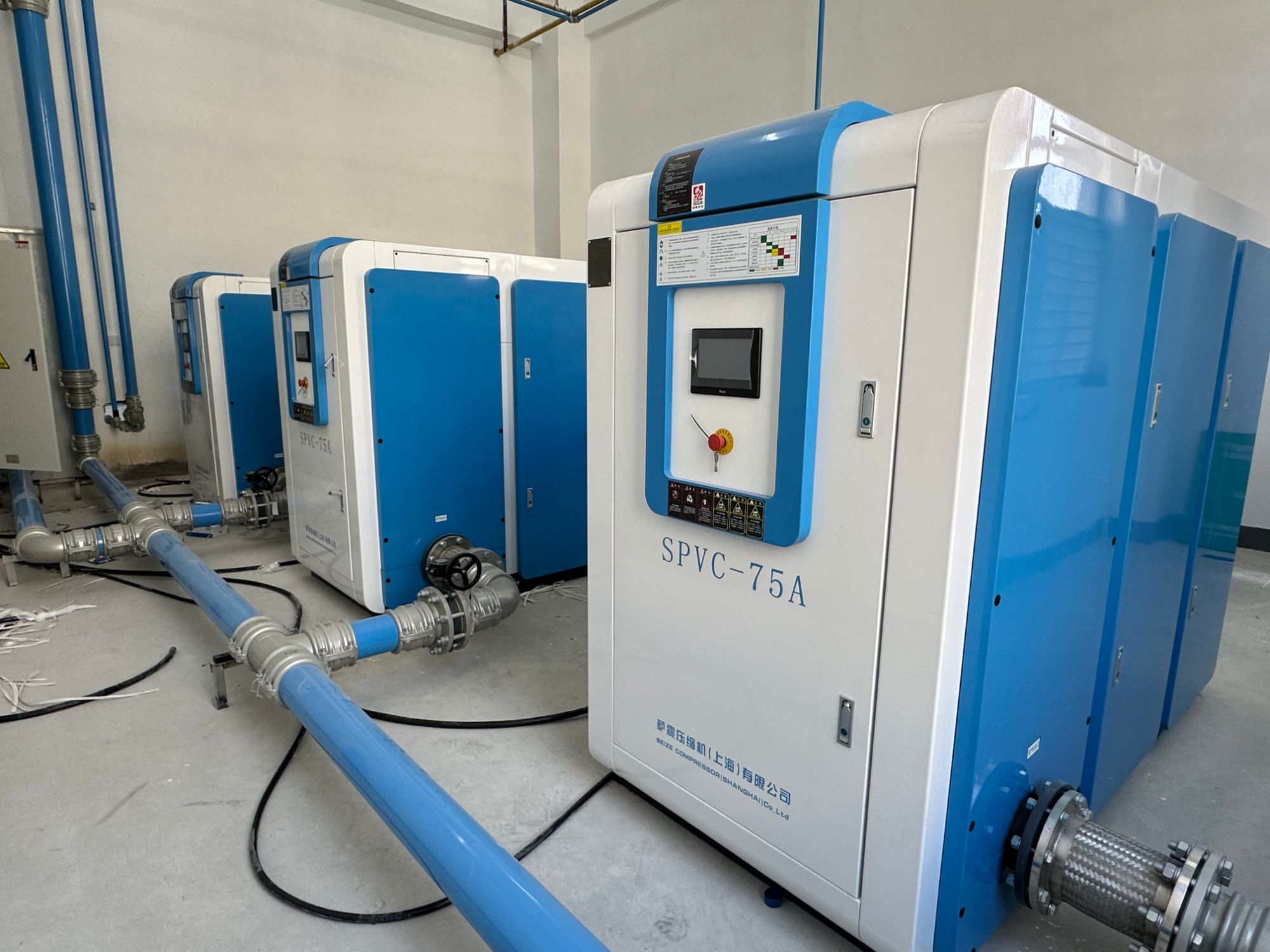
Rotary screw blowers don’t punish you for turning down the flow. Unlike lobe-type machines that build pressure against a fixed displacement and simply vent the excess, a screw element compresses air internally. At partial load, the built-in volume ratio keeps working in your favor, so the power draw drops off much more closely with actual demand instead of flatlining above it.
That gap widens further when you pair the screw airend with a variable speed drive. The rotors can slow down without losing their sealing integrity, so turndown doesn’t force you into wasteful blow-off or bypass loops. In practice, a screw blower running at 60 percent flow will often use noticeably less energy per cubic meter than a conventional unit at the same point, which quietly reshapes the payback math for plants with fluctuating air needs.
Part of the edge comes from staying cooler during those long stretches below full capacity. Screw blowers avoid the continuous backpressure spikes that force hot air past clearances, so bearing temperatures and discharge air stay lower. That spare thermal room translates into longer service intervals and fewer unplanned stops, even when demand rarely reaches the nameplate rating.
The Lifetime Cost Trap: Energy, Maintenance, and Downtime
Many buyers fixate on sticker price, but the real drain shows up later. A motor that costs $2,000 upfront can quietly burn through $18,000 in electricity over a decade, while a slightly more efficient unit might cut that by a third. Maintenance adds another layer: cheap components wear faster, demand more frequent replacements, and often require specialized technicians who charge premium rates. Those line items rarely appear in the initial budget.
Downtime is where the trap snaps shut. Every hour a production line sits idle isn't just lost output; it's wages paid for standing crews, missed delivery penalties, and the overtime needed to catch up. A unit with a lower purchase price but a history of unplanned stoppages can erase its savings in a single shift. Factories with tight margins have started calculating ten-year total cost, not the number on the invoice.
Turndown Ratio: The Spec That Separates Efficient Blowers from Power Hogs
Turndown ratio tells you how far a blower can throttle back from its maximum rated flow before it has to cycle off or waste energy. It's usually expressed as a ratio, like 10:1 or 20:1, where the first number is the full-flow capacity and the second is the lowest stable output. A blower with a 10:1 turndown can run smoothly at 10% of its full output, which matters more than peak specs in real plants where demand rarely sits at design conditions.
The difference shows up on the electric bill. Fixed-speed blowers often meet reduced air demand by venting or using inlet throttling—methods that keep the motor pulling nearly full power while doing less useful work. A blower with a wide turndown uses variable speed or adjustable guide vanes, so power draw drops in a steep curve as flow decreases. In many applications, cutting flow by 30% can slash energy consumption by half, which is why a high turndown ratio is a fast way to spot machines that won't become power hogs.
When comparing specs, don't stop at the headline number. Check the minimum stable flow and the efficiency curve across that range. Some vendors list a generous turndown but the blower vibrates or loses efficiency below 40% output. Ask for actual performance data at partial load—especially if your process runs at several different flow levels—because the real cost of a low turndown unit is paid out slowly every month in wasted kilowatt-hours.
Noise Limits, Footprint, and Heat: Overlooked Site Constraints
When a site gets evaluated, the conversation usually starts with square footage and available utility capacity. What gets skipped until later—sometimes too late—are the quieter restrictions: municipal noise ordinances that cap decibel levels at the property line, especially during evening hours. A generator or cooling system that seems fine on a spec sheet can easily breach those limits once you add reflective surfaces or an adjacent residential zone. Retrofitting for sound attenuation after installation is far more expensive than accounting for it in the initial layout.
Footprint is another number that misleads if you only look at the equipment's physical dimensions. Real footprint includes clearance for airflow, door swings, cable bends, and safe access for maintenance. On a constrained site, those extra meters stack up quickly and can push a project into non-compliance with setback rules or fire code. Then there is waste heat. Even when cooling capacity is sized correctly, the hot air has to go somewhere. If that exhaust points toward a walkway, a neighbor's window, or back into an intake, you create thermal discomfort, equipment throttling, or a noticeable plume that draws complaints.
Sizing for Tomorrow’s Load Without Paying for It Today
Too often, capacity planning falls into a trap: build for the absolute peak you might hit in three years, and you end up paying for idle hardware, cooling, and floor space long before that demand ever shows up. The smarter move is to think in terms of staged expansion. Look at your real growth curve, not the hockey-stick slide from a vendor deck. If your current utilization is sitting at forty percent, you don't need a box that handles four times that overnight. You need a platform that can add compute, storage, or throughput in smaller, cheaper increments as your actual traffic climbs.
This is where modular, software-defined setups earn their keep. Instead of replacing an entire chassis or forklifting a new cluster into the rack, you can often drop in another node, add a disk shelf, or spin up additional virtual instances on hardware you already own. The key is designing for headroom that costs little in the near term: reserve physical slots, network ports, and power circuits up front, but delay the expensive silicon and spinning disks until the monitoring data says you're within striking distance of a real bottleneck. That way, tomorrow's load gets a clear path to grow into, while today's budget stays focused on what users are actually doing right now.
None of this means ignoring future needs. It means separating the cheap, long-lead-time parts of expansion from the costly, fast-depreciating ones. Run regular capacity reviews tied to observed latency, queue depth, and error rates rather than a fixed calendar. When a threshold trips, buy the next increment. You'll still be ready for growth, but you won't be carrying the depreciation, power draw, and maintenance burden of a system sized for a day that hasn't arrived.
FAQ
Start from the biological oxygen demand and the basin depth rather than guessing from tank size alone. Calculate the oxygen transfer requirement under worst-case summer conditions, then add enough pressure margin for diffuser fouling and piping losses. Many operators undersize because they use clean-water specs instead of mixed-liquor conditions.
Positive displacement units, like rotary lobe or screw blowers, hold flow nearly constant even when discharge pressure shifts, which helps with diffuser fouling. Centrifugal blowers rely on speed and are more sensitive to pressure changes but can be more efficient at stable, lower-pressure duties. The choice often comes down to whether your aeration basin pressure varies much day to day.
Blowers can account for more than half of a plant's total electricity use, and they run continuously for years. A slightly cheaper blower with poor turndown or low wire-to-air efficiency can wipe out the purchase savings within the first 12 to 18 months of power bills. It is smarter to compare lifecycle cost per kilogram of oxygen delivered, not just the price tag.
Look at diurnal and seasonal load swings, not just average daily flow. If you size for peak summer night demand and run at 100% all day, you waste energy the rest of the year. Consider two or more smaller blowers with staged control or a variable speed drive, and check the turndown ratio so you can run efficiently at 30-40% of peak flow without surging.
Rotary lobe blowers are simple and tolerate some abuse, but they need regular belt and oil checks and can get noisy. Screw blowers have fewer wearing parts and run cooler, but they demand clean intake air and precise clearances. Centrifugal blowers with magnetic or air bearings have minimal contact wear, yet the controls and backup power are more critical. Ask for actual service intervals and parts availability in your region before deciding.
Yes, and it is often overlooked until after installation. High-speed centrifugal blowers can be quiet inside the room but need careful enclosure cooling; positive displacement blowers can easily exceed 85 dBA and require acoustic treatment if there are residences nearby. Heat rejection also changes the ventilation load, which can shorten the life of electrical panels if the blower room is not designed for it.
Usually yes, unless your plant runs at a constant heavy load all year. Variable speed lets you match airflow to dissolved oxygen setpoints instead of blowing excess air and wasting power. However, not every blower type handles turndown the same way, so pair the drive with a machine that has a wide, surge-free operating range and a control system that actually modulates speed based on DO feedback.
They forget about altitude and intake air temperature, which reduce mass flow and oxygen delivery on hot days. They also overlook simple things like adequate filtration for dusty sites and the need for a properly sized air receiver or silencer. Another common miss is buying a blower that fits today's flow but has no room to add a second unit later, so future expansion forces a complete replacement instead of a simple addition.
Conclusion
Choosing a blower for wastewater treatment starts with reading the aeration basin's actual oxygen demand, not just relying on design averages. Real loads fluctuate, and a blower that matches peak conditions may waste energy at lower loads. This is where screw blowers often hold an edge; their efficiency curve stays flatter under partial loads compared to traditional lobe or centrifugal designs. But even the best machine loses its appeal if you ignore the lifetime cost trap. Upfront price is only a fraction—energy consumption dominates operating expenses, while maintenance frequency and unexpected downtime can quietly erase any initial savings. One spec that separates efficient blowers from power hogs is turndown ratio. A high turndown ratio means the blower can efficiently modulate airflow across a wide range, preventing the all-too-common scenario of running a large blower at 30% capacity while burning full power.
Site constraints often sneak up on designers. Noise limits in residential or indoor installations can force expensive acoustic enclosures, so checking sound levels early avoids retrofit headaches. Footprint matters when space is tight in older plants, and heat rejection can overload ventilation systems if overlooked. Finally, sizing for tomorrow's load without paying for it today requires a balanced approach. Oversizing for a future expansion may seem prudent, but it locks you into higher energy and capital costs now. Instead, consider modular blowers or variable speed drives that let you add capacity later without overbuying today. The right choice isn't the most powerful or the cheapest—it's the one that aligns with your basin's real demand curve, your site's physical limits, and a clear-eyed view of total cost over the next decade.
Contact Us
Contact Person: Mia
Email: [email protected]
Tel/WhatsApp: +86 19821985894
Website: https://www.seize-air.com