

Chemical Soil Stabilizer: Unlocking Stronger Foundations for Safer Roads and Structures
2026-07-29
Every road and structure begins beneath the surface, where unstable soil quietly threatens durability and safety. Chemical soil stabilization transforms these hidden risks into unshakable support, locking particles together for foundations that resist erosion and heavy loads. At MST, pioneering solutions are redefining how engineers tackle weak ground — turning questionable terrain into reliable groundwork faster and more sustainably than traditional methods. As demands on infrastructure grow, understanding this science isn’t just technical, it’s essential for tomorrow’s resilient highways and buildings.
The Hidden Chemistry That Turns Weak Soil into Load-Bearing Bedrock
Right beneath our feet, an invisible transformation quietly reshapes the ground. Ordinary soil, often too soft or unstable to support heavy structures, can be turned into something resembling solid bedrock—not through magic, but through a careful orchestration of chemical reactions. Engineers and geologists have long known that by introducing specific compounds into the ground, they can trigger processes that bind loose particles together, fill pores, and dramatically increase strength. This isn't just about pouring concrete; it's about working with the soil's natural chemistry to create a durable foundation that nature might have taken millennia to form.
One of the most intriguing methods involves a biological catalyst—common bacteria that feed on urea and produce calcite, a mineral that cements soil grains in place. As these microbes multiply and spread through the pores, they excrete calcium carbonate, slowly turning a loose sand into a sandstone-like mass. The reaction is both elegant and effective: it doesn't require extreme temperatures or heavy machinery, yet it can double or triple the bearing capacity of the ground. Field trials have already demonstrated its potential to stabilize slopes, reinforce foundations, and even repair cracks in existing structures without disrupting the surrounding environment.
From Mush to Monolith: A Look at How Polymers and Binders Reinforce Subgrades
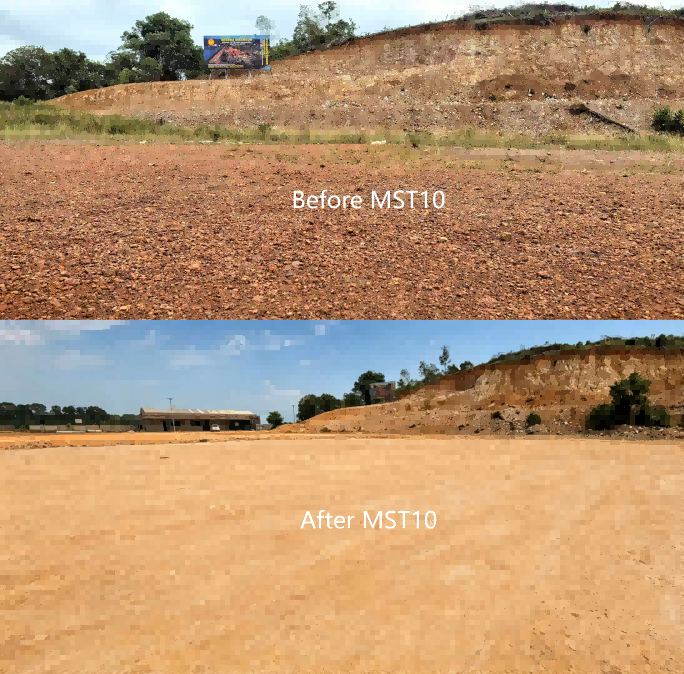
The transformation of a weak, yielding subgrade into a robust foundation often starts at the molecular level. When polymers are introduced, they create long-chain networks that bind soil particles together, boosting cohesion and reducing void ratios. This isn't just about drying out wet earth—it's a chemical reinforcement that turns loose sediments into a durable, load-bearing layer capable of handling heavy traffic and resisting erosion over time.
Binders like cement, lime, or proprietary polymer blends react with silt and clay minerals to form cementitious bonds. As these reactions progress, the subgrade stiffens, swelling potential drops sharply, and its bearing capacity multiplies. What was once a spongy mess becomes a stiff, slab-like base that distributes loads evenly, preventing rutting and cracking in the overlying pavement. Engineers can fine-tune the formulation to match specific soil chemistries and performance demands.
In the field, the shift from mush to monolith is almost startling. Treated subgrades go from unworkable to traffickable in hours, not days, dramatically accelerating construction schedules. The long-term payoff includes reduced maintenance cycles and less material replacement, as the stabilized layer shrugs off freeze-thaw cycles and moisture intrusion. It's a practical, low-impact approach that extends the life of roads, runways, and industrial floors without resorting to deep excavation or full-depth reclamation.
Weathering the Extremes: How Treated Soils Stand Up to Freeze-Thaw and Flooding
When winter shifts to spring, the ground endures a brutal cycle of freezing nights and thawing days. Untreated soils expand as ice lenses form, then collapse into a soupy mess when they melt, eroding stability and swallowing structures. But soils reinforced with advanced binders tell a different story—their internal matrix resists water infiltration from the start, preventing the deep frost penetration that triggers heaving. Even after repeated freeze-thaw cycles, these treated layers retain their compaction and load-bearing capacity, shrugging off the stresses that fracture ordinary ground.
Flooding poses an equally merciless test. Saturated, untreated soils quickly lose cohesion, turning into a quagmire that flows like liquid. Treated soils, however, form durable aggregates that stand firm underwater, with chemical bonds that refuse to dissolve. Instead of washing away, they channel excess moisture through controlled pathways, acting almost like a permeable pavement. This resilience means roads and foundations stay put long after the floodwaters recede, a direct result of the hydrophobic and cementitious reactions engineered into the soil matrix during treatment.
The true measure of this technology emerges in the aftermath of extreme weather events. While conventional ground requires extensive repairs—recompaction, regrading, even total replacement—treated soils often need nothing more than superficial touch-ups. Field observations show that sites stabilized with polymer or cementitious additives exhibit less than half the surface degradation of untreated areas after identical exposure. By fundamentally altering how soil particles interact at the microscopic level, these treatments create a living, breathing framework that adapts to moisture flux without surrendering its strength, proving that resilience isn't about resisting nature, but working with it.
Beyond Traditional Compaction: When Mechanical Force Isn’t Enough
Traditional compaction methods rely on straightforward mechanical pressure to force particles together, but this approach often hits a wall with modern materials. Powders with irregular shapes, high moisture sensitivity, or extreme fineness can resist simple compression, forming resilient bridges that trap air and prevent full densification. Even under immense loads, internal friction between grains can redistribute stress unevenly, leaving weak zones that compromise the final product's integrity.
The limits become glaringly obvious when working with nano-sized powders or fiber-reinforced composites. At these scales, interparticle forces like van der Waals attraction and electrostatic charges dominate, making mechanical pressure alone ineffective at rearranging particles. Similarly, materials that require a specific orientation of reinforcement fibers can't be forced into place without risking breakage or misalignment. Here, energy inputs beyond brute force—such as controlled vibration, ultrasonic agitation, or thermal softening—become essential to overcome cohesion and achieve a homogeneous structure.
Alternative techniques fill the gap by introducing dynamics that mechanical force cannot replicate. Isostatic pressing applies uniform pressure from all directions, eliminating shear stress concentration. Vibration-assisted compaction uses high-frequency oscillations to temporarily break interparticle bonds, allowing grains to slide into denser configurations. For thermally sensitive or extremely hard materials, techniques like spark plasma sintering combine heat and pressure to fuse particles without the long dwell times that cause grain growth. These methods remind us that compaction is not just about pressing harder but about mobilizing particles intelligently.
Greener Groundwork: Using Industrial Byproducts for Lasting Stabilization
Traditional soil stabilization often leans heavily on cement and lime, but their production carries a steep carbon footprint. Shifting focus to industrial byproducts like fly ash, slag, and silica fume not only diverts waste from landfills but also unlocks chemical properties that rival—or even outperform—conventional binders. These materials quietly transform weak soils into durable foundations, all while sidestepping the environmental toll of virgin resource extraction.
What makes this approach compelling is the long-term resilience it offers. Byproducts such as blast furnace slag react slowly with soil particles, forming stable compounds that resist erosion and moisture damage for decades. Engineers are now tuning these mixtures to site-specific conditions, achieving stabilization that adapts to local geology rather than fighting against it. The result is less maintenance, fewer rebuilds, and a groundwork that actually grows stronger with time.
Infrastructure Under Pressure: Real-World Cases Where Stabilization Prevented Catastrophe
The 2017 Oroville Dam crisis in California serves as a stark reminder of how close we can come to disaster when critical infrastructure begins to fail. After heavy rainfall, the dam's main spillway suffered a massive concrete slab collapse, threatening the integrity of the emergency spillway. With nearly 200,000 residents evacuated downstream, engineers raced to stabilize the structure by reinforcing the eroded hillside with rock and concrete, ultimately preventing an uncontrolled release of water that could have inundated entire communities.
In 2018, a different kind of pressure test unfolded beneath the streets of Seattle during the excavation for the Alaskan Way Viaduct replacement tunnel. Contractors encountered unexpected soil instability that led to a sinkhole opening up near the waterfront. Immediate stabilization measures—including the injection of stabilizing grout and careful realignment of the tunnel boring machine—halted further ground movement and safeguarded nearby historic structures and piers.
Across the Atlantic, the rapid response to the 2020 Furnas Dam crisis in Brazil highlighted the value of proactive monitoring. When sensors detected unusual displacement in the dam wall, engineers swiftly lowered reservoir levels and shored up the structure with additional buttressing. This averted a potential breach that could have released a torrent of mining waste into the surrounding valley, protecting both lives and ecosystems.
FAQ
It alters the soil's physical and chemical properties, binding particles together to boost strength, reduce water absorption, and prevent shifting. Essentially, it turns loose earth into a reliable construction base.
Mechanical compaction alone often fails with weak or wet soils. Chemical stabilizers create permanent bonds at the molecular level, working deep within the matrix — not just on the surface — so the stabilization lasts longer and resists weather damage.
You'll see them used under highways, airport runways, building foundations, and even in slope protection. Anywhere subsurface failure would be catastrophic, chemical stabilization provides an extra layer of security that simple compaction can't offer.
Modern formulations are designed with the environment in mind, often using non-toxic, biodegradable components. However, site-specific testing is crucial to prevent leaching into groundwater and to ensure compatibility with local ecosystems.
Not all soils respond well. Expansive clays and certain silts often see dramatic improvement, while highly organic or contaminated soils might need specialized blends. A thorough geotechnical analysis always precedes the decision to treat.
It starts with soil pulverization, followed by mixing in the liquid stabilizer at a precise dosage — often using large recycler machines. After spreading and grading, the treated layer is compacted and left to cure. Timing and moisture control are critical throughout.
If properly designed and installed, it can keep its integrity for decades with minimal maintenance. Its resistance to freeze-thaw cycles and erosion often outperforms untreated layers, cutting lifecycle costs significantly.
Upfront costs can be higher, but the long-term savings from reduced maintenance, fewer repairs, and shorter construction delays typically tip the scales. For large-scale projects, the return on investment becomes clear once you factor in extended service life.
Conclusion
Chemical soil stabilization is revolutionizing infrastructure by transforming weak, unstable soils into durable, load-bearing layers. Through advanced chemical reactions, liquid additives like polymers, cementitious binders, and ionic compounds penetrate the soil matrix, creating bonds that significantly improve compressive strength and resilience. Unlike traditional mechanical compaction, which merely densifies the ground, chemical stabilizers alter the soil's mineralogy at a molecular level, turning mush into monolith. This hidden chemistry is the key to building safer roads and foundations on problematic subgrades such as expansive clays or loose sands, reducing the risk of settlement and structural failure.
Beyond mere strength enhancement, these treatments fortify subgrades against environmental extremes. Stabilized soils exhibit remarkable resistance to freeze-thaw cycles and flooding, preventing the damaging expansion and contraction that plague untreated earth. Moreover, the integration of industrial byproducts like fly ash and slag into stabilization formulas is driving greener groundwork, repurposing waste materials while reducing carbon footprints. Real-world cases underscore the value: from reinforcing highway embankments to preventing landslide catastrophes, chemical soil stabilization has repeatedly proven its worth, ensuring infrastructure integrity under the harshest pressures.
Contact Us
Contact Person: Helen
Email: [email protected]
Tel/WhatsApp: 86 18630661160
Website: https://www.roadmilestone.com/