

Calcium Sulfate Six-Sided Steel-Faced Floor Factory Production Process Explained
2026-11-16
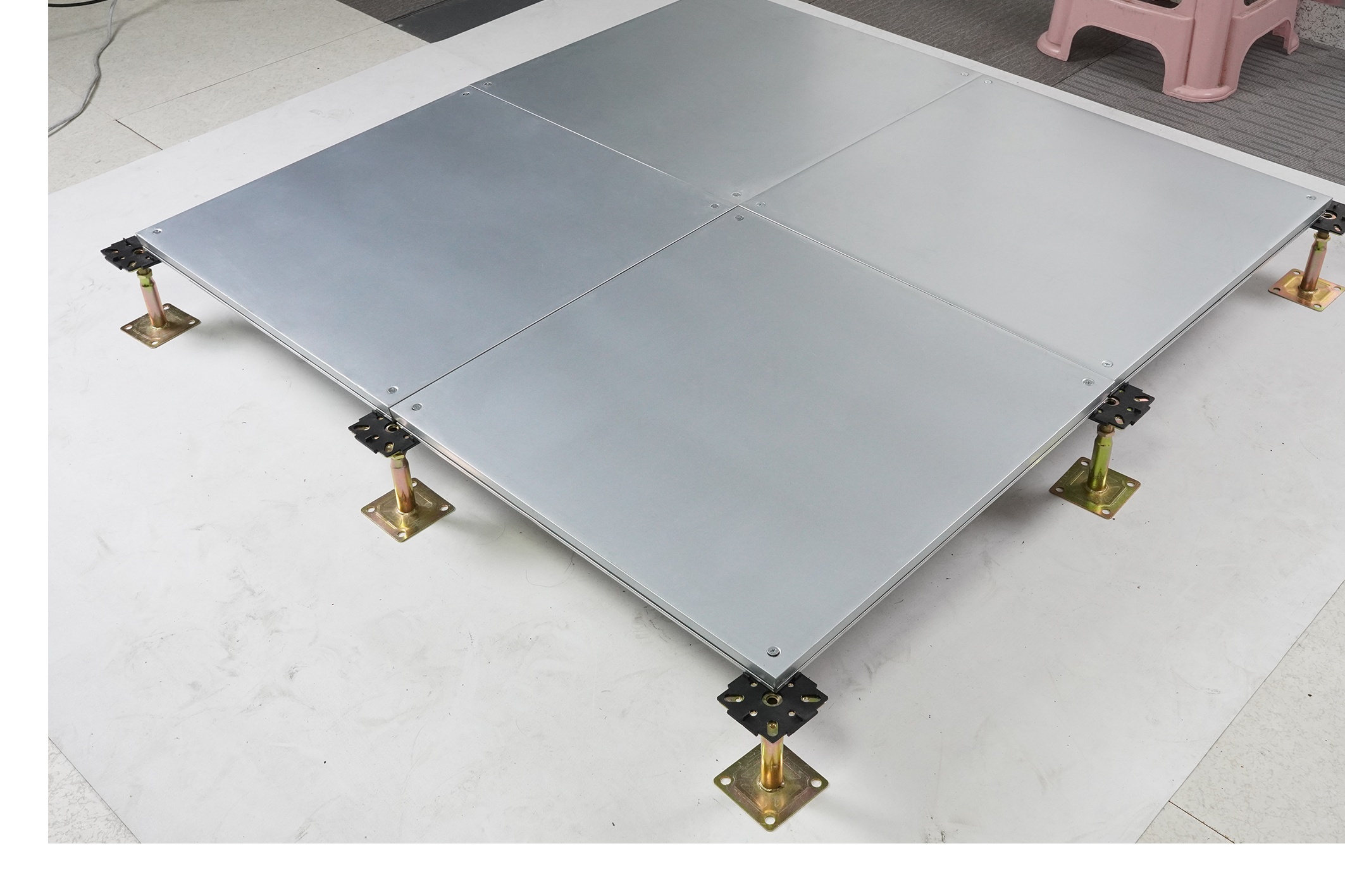
Ever wonder what actually goes into a raised floor panel that doesn't crack under heavy office traffic? A calcium sulfate core gets sealed in steel on all six sides—top, bottom, and every edge. At Lipin Floor, the production process is a mix of precision coating, pressing, and edge welding that most spec sheets never show. Here's a closer look before the next panel rolls off the line.
Gypsum Powder Purity Checks Happen Before Anything Else
You can’t build a solid product on a shaky foundation, and that’s exactly why purity checks on gypsum powder come first in our process. Every batch gets screened for impurities like clay, limestone, or organic matter before it ever touches water or other additives. We pull samples from multiple points in the delivery, not just the top layer, because what’s clean on the surface might hide trouble underneath. A quick visual scan isn’t enough — we run fineness tests and chemical assays to catch even trace contaminants that could weaken the final set or leave uneven patches.
Once the numbers come back, they get logged against the supplier’s certificate and our own baseline. If the purity dips below the threshold, the whole load is quarantined, no exceptions. This isn’t about being fussy; it’s about avoiding rework later when cracks or soft spots show up in drywall or molds. The lab notes often reveal surprising variance between shipments, even from the same quarry, which is why skipping this step is a gamble we won’t take.
What makes our approach different is that we don’t just test for what’s present — we test for what’s missing. High-purity gypsum should have predictable water demand and setting behavior, so we compare each batch against a reference curve from a known clean sample. If it drifts too far, we know something’s off before a single bag is opened. That kind of early signal keeps the rest of the production line honest, and it’s the reason purity checks gate everything that follows.
Mixing Water and Calcium Sulfate to a Specific Viscosity
Getting a calcium sulfate slurry to a particular viscosity starts with the water-to-powder ratio, but it is not a fixed number for every batch. The hemihydrate form reacts quickly enough that the reading you get at one minute can be much lower than at three minutes. A reliable approach is to weigh the powder, add about 80% of the expected water first, mix for 60 seconds, then add the remaining water in small pours while checking with a flow cup or rotational viscometer. Stopping when the target is first reached usually means the slurry will still thicken slightly over the next minute, so the target should account for that drift.
Temperature and mixing energy also shift the result. Cold water slows the hydration reaction and gives you a little more open time, while warm water pushes the slurry toward the higher end of the viscosity range faster. Mixing by hand produces a different curve than a high-shear mixer, so keep the method consistent. If the slurry overshoots and becomes too thick, adding a few drops of water and folding it in gently can bring it back, but avoid aggressive remixing once the crystalline network has started to form because that can permanently lower the final viscosity.
For repeatability, record the exact powder weight, water temperature, mixing time, and resting period. A short rest of about 30 to 60 seconds after the initial mix allows the calcium sulfate particles to wet out fully, and a gentle remix before measuring removes air pockets without destroying the developing structure. Small adjustments to the water content, sometimes as little as half a percent of the total, are usually enough to shift a borderline batch into the desired range.
Vibration-Assisted Pouring Removes Air from the Core
When molten metal enters a mold cavity, trapped air and evolved gases tend to collect in the deepest sections of the core, creating voids that compromise casting integrity. Applying controlled mechanical vibration during the pour changes this behavior. The oscillations travel through the mold and into the liquid metal, causing bubbles to coalesce and migrate upward along the core walls instead of staying pinned. Small, high-frequency vibrations work particularly well because they reduce the apparent viscosity of the liquid, letting entrained air escape through risers or vents before the metal solidifies.
The pattern of vibration matters as much as its intensity. A single, continuous frequency can push bubbles into a standing wave node and hold them there, while short bursts with varying amplitude create a scrubbing effect along the core surface. Operators often report that a low-amplitude sweep starting around 30 Hz and ramping to 90 Hz clears more porosity than a fixed setting, because it prevents air pockets from settling into stable locations. For complex cores with narrow passages, adding vibration only during the initial fill stage keeps the metal fluid enough to release gas without introducing turbulence that could erode the core.
Core temperature also influences how well vibration works. A colder core cools the metal quickly at the interface, forming a thin solidified skin that can trap bubbles before they reach a vent. Preheating the core to between 150 °C and 200 °C, combined with vibration, delays that skin formation and gives trapped air a longer escape window. In production settings, the best results come from synchronizing the vibration pulse with the pour rate, so the molten metal arrives at the core's deepest recess with enough kinetic energy to drive out gas pockets rather than simply covering them.
The Six-Sided Steel Wrap Uses a Heat-Activated Adhesive
The six-sided steel wrap gets its grip from a heat-activated adhesive film that stays inert at room temperature. You won't notice any tackiness while positioning the wrap around a tool, shaft, or pipe—the surface feels dry and easy to slide into place. Once heat is applied with a heat gun or even a lighter, the adhesive softens, flows into the micro-roughness of the steel, and locks the wrap into a rigid, vibration-resistant sleeve.
Because the bonding process is triggered by temperature rather than pressure alone, you get a wider working window for alignment. The six-sided geometry helps the wrap bite into corners and flat faces, preventing rotation under load. After cooling, the adhesive cures to a hard finish that resists oils, moisture, and common shop chemicals, so the wrap won't peel back at the edges during regular use.
One practical trick is to heat the wrap in short passes instead of holding the heat source in one spot. This lets the adhesive activate evenly across all six sides, avoiding soft spots that could lead to uneven bonding. The result is a clean, tight fit that feels closer to a factory-applied sleeve than an aftermarket add-on.
Slow-Curing the Panels Locks in Strength and Flatness
Rushing the cure often leaves uneven internal stress, which shows up later as warped boards or weak spots. By extending the cure cycle to a slower, more deliberate pace, the resin has time to crosslink evenly across the entire panel. That even bond is what gives the finished board its rigidity without locking in distortion.
Flatness isn’t just a visual trait; it’s a structural one. A panel that cures too fast can look fine off the line and then bow once it hits different humidity or temperature. The slow-cure approach lets the material settle into a neutral state, so the panel stays flat in real-world conditions instead of just in the factory.
Final Load Testing Simulates Years of Foot Traffic
Before any product ships, we run it through a machine that mimics the repetitive pressure of footsteps over a long span. A weighted roller or pneumatic piston cycles back and forth across the surface, applying hundreds of thousands of passes in a matter of days. This isn't just a quick scuff test; it's designed to reproduce the dull wear, micro-abrasions, and finish degradation that normally take a decade or more to appear in a busy hallway.
The test slab is inspected under angled light at set intervals—usually every 50,000 cycles—to catch early signs of thinning, cracking, or loss of traction. We also rotate the sample halfway through to rule out any bias from the machine's stroke pattern. Anything that survives the full sequence without delamination, surface haze, or measurable wear beyond a tight tolerance gets approved for production.
What makes this step useful is the boring, unglamorous repetition. A material might feel sturdy in a showroom, but force it through the equivalent of twenty years of foot traffic in a week and flaws surface quickly. It's a final gate that separates products that hold their look from ones that only pass a first impression.
FAQ
The core starts with high-purity calcium sulfate hemihydrate blended with water and a small amount of reinforcing fiber. Some plants also add a retarder to control setting time and a plasticizer to keep the slurry workable before pressing.
The slurry is poured onto a continuous forming line and spread to a precise thickness, then compacted under rollers to squeeze out excess water and eliminate air pockets. It sets quickly through hydration and is cut into standard panel dimensions before drying.
The dried calcium sulfate core is wrapped in galvanized steel on the top, bottom, and all four edges. This is usually done by folding a pre-cut steel sheet around the core and mechanically crimping or bonding the edges so no core material remains exposed.
After folding, the panels go through a press that applies even pressure across the face while edge rollers close the seams. Many factories use a structural adhesive between the steel and core to prevent delamination and improve impact resistance.
Panels pass through a multi-zone drying oven where temperature and humidity are controlled to remove residual moisture without warping the core. If moisture remains, the steel can corrode from the inside and the panel may lose dimensional stability.
Each panel is checked for thickness tolerance, flatness, and seam tightness. Random samples are subjected to load tests, drop tests, and surface hardness checks. The steel wrap is also visually inspected for scratches or incomplete folds.
Raw materials are mixed into slurry, formed into a slab, cut, dried, wrapped with steel on all six sides, pressed and edge-sealed, then cured under pressure, dried again if needed, inspected, and palletized. The exact order can shift slightly depending on the line design, but the steel wrapping always comes after the core is solid and dry.
Calcium sulfate offers high compressive strength, fire resistance, and good acoustic damping while staying lighter than concrete. It also machines cleanly, so factory cutting is precise and generates less dust than wood-based cores.
Conclusion
At the heart of this flooring system is a production sequence that refuses to cut corners on raw material quality. Before any mixing vessel is filled, incoming gypsum powder undergoes a series of purity checks—moisture content, particle distribution, and chemical composition are all verified against strict internal thresholds. Only batches that pass move to the blending stage, where water and calcium sulfate are combined and stirred until the slurry reaches a carefully controlled viscosity. Too thin and the core loses density; too thick and the panels become difficult to pour evenly. The actual casting step relies on vibration-assisted pouring, a technique that shakes the liquid mixture just enough to coax trapped air bubbles to the surface and out of the core. This step is what gives the finished board its uniform density and prevents weak spots that would show up later as hairline cracks or soft edges.
Once the core is cast and still workable, each panel gets wrapped on all six sides with a steel facing. Instead of relying on mechanical fasteners, a heat-activated adhesive bonds the metal skin to the gypsum core—heat is applied briefly to trigger a chemical cross-linking reaction that locks the wrap in place without adding thickness or leaving visible screw heads. The wrapped panels then move into a slow-curing chamber, where temperature and humidity are held within narrow bands for a deliberate stretch of time. This controlled cure is what allows the calcium sulfate to develop full compressive strength and keeps the panels from bowing or twisting as they dry. Before any unit leaves the factory, it undergoes final load testing designed to mimic years of foot traffic: repeated point loads, rolling carts, and edge pressure are applied in cycles. Panels that survive these simulations without measurable deflection or delamination are the only ones cleared for shipment—everything else gets pulled from the line and recycled back into the raw material stream.
Contact Us
Contact Person: yuki
Email: [email protected]
Tel/WhatsApp: +86 18664390732
Website: https://www.lipinfloor.com/