Best Sintered Silicon Carbide Materials for Extreme Durability and Performance
2026-09-29
When the toughest industrial challenges demand materials that refuse to fail, sintered silicon carbide stands alone. From punishing chemical environments to high-temperature mechanical stress, only the best grades deliver the extreme durability and performance that modern engineering requires. HUAYI TECH has been quietly perfecting these advanced ceramics for years, and in this article we break down what actually separates premium sintered SiC from the rest. If you've ever wondered why some components outlast their specifications while others crack under pressure, keep reading.
Why Sintered Silicon Carbide Thrives in Punishing Environments
In punishing environments where abrasive slurries, corrosive chemicals, and extreme temperatures are the norm, most materials surrender quickly. Sintered silicon carbide refuses that path. Its near-diamond hardness—typically 9.5 on the Mohs scale—means that even high-velocity particles and gritty media barely leave a mark. The material’s dense, low-porosity microstructure, achieved through pressureless sintering or reaction bonding, gives it an exceptionally uniform surface that resists erosion far longer than oxide ceramics or hardened steels.
Thermal shock is another silent killer in demanding industrial settings. Sintered silicon carbide sidesteps this threat with a thermal conductivity that rivals some metals while maintaining a remarkably low coefficient of thermal expansion. Rapid swings from cryogenic cold to red-hot operation don’t produce the microcracking that plagues alumina or zirconia. When paired with its innate resistance to oxidation at high temperatures—thanks to a self-forming silica layer—the material keeps its mechanical integrity in furnaces, burners, and heat exchangers where others crack, warp, or scale.
Then there’s the chemical battlefield. From concentrated acids to molten salts, sintered silicon carbide refuses to corrode or leach. It shrugs off hydrofluoric acid, hot caustic solutions, and aggressive solvents that would eat through stainless steel in hours. This inertness, combined with low friction and self-lubricating properties in many tribological applications, makes it the default choice for mechanical seals, pump shafts, and valve components in oil refineries, chemical plants, and semiconductor fabs. In these punishing environments, downtime isn’t an option—and sintered silicon carbide quietly delivers decades of uninterrupted service.
The Microstructure That Laughs at Wear and Fracture
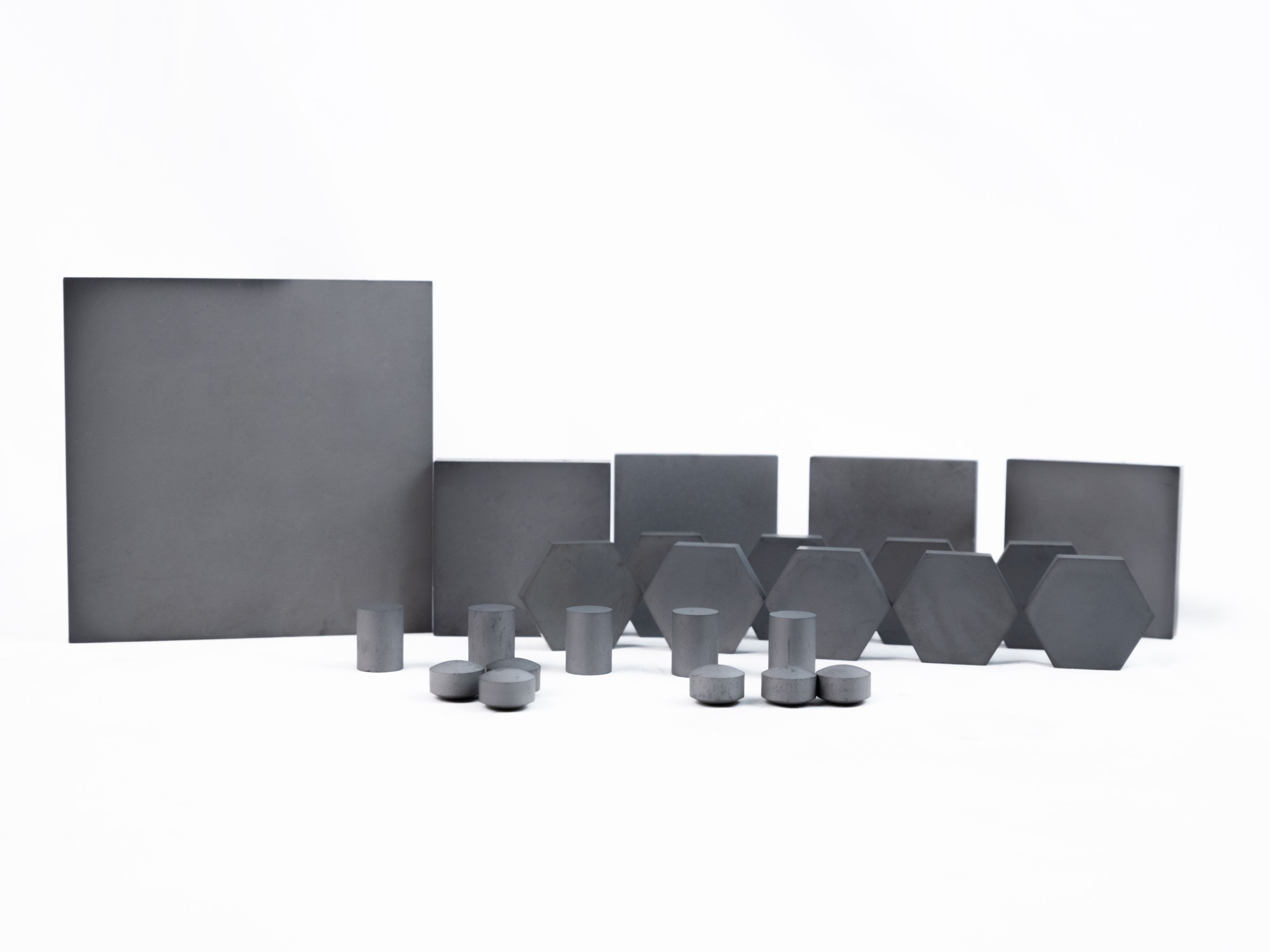
A material's resistance to wear and fracture often hinges on features invisible to the naked eye. In this particular alloy, the grain boundaries are not straight lines but a tangled, interlocking mesh that resembles a three-dimensional jigsaw puzzle. This irregular network forces a propagating crack to constantly change direction, expending energy at every turn until it simply runs out of momentum. The result is a structure that doesn't just endure surface abrasion—it absorbs the damage and redistributes it across thousands of micro-joints, so that a single scratch rarely becomes a catastrophic failure.
What makes the design especially clever is the deliberate inclusion of nano-scale precipitates along those wavy boundaries. These particles are harder than the surrounding matrix, so when a wear scar tries to plow through, the precipitates act like speed bumps that blunt the cutting edge. Under repeated loading, they shed tiny, plate-like debris that forms a self-lubricating film, reducing friction and further slowing material loss. It's a built-in defense mechanism: the more the surface is worked, the more it coats itself with a protective layer, turning mechanical stress into a maintenance routine.
Testing under abrasive slurry and cyclic bending reveals a curious behavior. Instead of a gradual decline in strength, samples often show a brief plateau where their toughness actually improves. This is because micro-cracks at the interface between precipitate and matrix open just enough to relax internal stress, then become pinned by the surrounding tangled grains. The material essentially performs microscopic self-repair through load redistribution, laughing at the usual rules of fatigue life. It's not magic—just a lesson in how chaos at the smallest scale can produce remarkable order under stress.
Chemical Inertness That Handles Acids Alkalis and Molten Metals
Few materials can shrug off boiling hydrochloric acid, hot sodium hydroxide, and a crucible full of molten aluminum without some kind of compromise. This material does exactly that. The surface doesn't form a passive layer that quietly dissolves over time; it simply refuses to participate in the reaction. For process engineers, that means no ion leaching into high-purity baths and no gradual thinning of vessel walls after hundreds of cycles.
Alkali resistance tends to trip up even acid-proof ceramics because hydroxides attack silica-based grain boundaries. Here, the structure is dense and free of those weak points, so concentrated caustic solutions cause little more than a rinseable film. With molten metals, the story shifts from corrosion to wetting: zinc, magnesium, or tin may pool against the surface but won't stick or penetrate, so crucibles and launders release cleanly without flux buildup.
That combination of traits shows up in places where contamination can't be tolerated—semiconductor etch lines, rare earth refining, molten salt reactors. Instead of swapping out liners or re-machining parts every few weeks, maintenance teams can stretch intervals significantly. The real benefit isn't just surviving aggressive chemistry; it's keeping the chemistry itself unchanged.
Thermal Shock Resistance From Red Heat to Rapid Quench
When a part glows red hot—somewhere between 700°C and 900°C for most steels—and is then plunged into cold water or oil, the outer skin contracts almost instantly while the core remains hot and expanded. This mismatch creates intense tensile stress at the surface. Materials that survive this brutal cycle without cracking or spalling are said to possess strong thermal shock resistance. It’s not a single property but a balance of thermal expansion, conductivity, and fracture toughness.
Low-expansion ceramics like silicon carbide and silicon nitride tend to handle red-heat-to-quench scenarios far better than glass or ordinary tool steels. That’s because they combine modest thermal expansion with high thermal conductivity, allowing heat to dissipate before stress concentrations build. Grain size and phase composition matter as well—some zirconia grades actually use a stress-induced phase transformation to absorb energy and stop crack propagation. Even the part’s cross-section plays a role: thin, uniform walls shed thermal gradients faster than thick, uneven sections.
In practical terms, components such as hot forging dies, furnace rollers, and rocket nozzles often face repeated cycles from red heat to rapid quench. Their service life hinges directly on this resistance. A common evaluation method involves heating a standardized sample until it glows, then quenching it in a bath at a fixed temperature and counting surface cracks or measuring retained strength. By tailoring the material’s chemistry and microstructure—or adding thermal barrier coatings—engineers can push the survival limit further.
Hardness Numbers That Put Tungsten Carbide to Shame
Tungsten carbide's reputation as an industrial workhorse often hinges on numbers like 1600 to 2400 HV on the Vickers scale, or roughly 9 on Mohs. That sounds formidable until you glance at a few other figures. Diamond, for instance, routinely logs 10,000 HV and tops the Mohs scale at 10, making it nearly five times harder in Vickers terms. Cubic boron nitride isn't far behind, often cited between 4,500 and 5,000 HV, which explains why it grinds through hardened steel without flinching.
Then there's boron carbide, a dark, lightweight ceramic that sits around 3,000 to 3,500 HV. It's cheaper than diamond and far lighter than tungsten carbide, yet it still bites into armor plate and abrasive slurries. Even some silicon carbides exceed 2,800 HV, edging out the best tungsten carbide grades by a comfortable margin. The difference shows up in real wear tests: a diamond indenter leaves almost no scratch on a polished carbide surface, while carbide itself cannot scratch a boron carbide tile without dulling.
What makes these numbers instructive isn't the ranking itself, but the gap. Tungsten carbide dominates metalcutting not because it's the hardest material known, but because it balances hardness, toughness, and cost. Once you cross into the 3,000 HV range, brittleness starts to climb and machining becomes more delicate. So the next time a spec sheet boasts about tungsten carbide's hardness, remember it's a middleweight in a field of superabrasives.
Choosing the Right Grade for High Stress Industrial Applications
In high stress industrial environments, grade selection isn't just about tensile strength on a datasheet. Components that face cyclic loading, impact, or sustained pressure need a balance of toughness, fatigue resistance, and ductility. A grade with excellent yield strength might still fail early if it's brittle at operating temperatures or sensitive to stress risers. Start by mapping actual service conditions—peak loads, load reversals, temperature swings, exposure to corrosive media—and then look for grades proven in similar applications.
Microstructure matters as much as alloy chemistry. Quenched and tempered steels, for example, offer a fine-grained martensitic structure that resists crack propagation better than a coarse-grained normalized alternative. For components under high contact stress, case-hardening grades can provide a hard, wear-resistant surface while retaining a tough core. Don't overlook cleanliness; inclusions and trace elements can dramatically reduce fatigue life, so specify grades with controlled sulfur and phosphorous levels where possible.
Finally, validate your choice through testing that mirrors real-world conditions. Standard tensile tests won't catch stress corrosion cracking or fretting fatigue. Charpy impact values at the minimum service temperature, rotating beam fatigue data, and full-scale component testing under simulated loads give a more realistic picture. It's also worth checking if a slightly more expensive grade can eliminate a heat treatment step or extend replacement intervals enough to justify the upfront cost.
FAQ
Unlike many ceramics that degrade under sliding contact, sintered SiC maintains a Vickers hardness above 2500 kgf/mm² and a fracture toughness that resists micro-chipping. Its self-mated friction coefficient stays low even without lubrication, which extends the service life of seals and bearings well beyond what alumina or tungsten carbide can offer.
The material's low thermal expansion (around 4.0 × 10⁻⁶ /°C) combined with high thermal conductivity (120–200 W/m·K) lets it dissipate heat quickly. That means a part can move from a cold start to a 1000°C environment in seconds, and thermal shock rarely causes spalling unless the geometry has sharp notches.
Sintered SiC is virtually immune to attack from sulfuric acid, hydrofluoric acid, and hot caustic solutions—media that chew through stainless steel and PTFE linings. Its porosity is nearly zero after sintering, so the corrosive fluid never reaches internal grain boundaries, eliminating the weak spots found in reaction-bonded grades.
Reaction-bonded SiC contains free silicon (typically 8–12%), which limits its maximum service temperature to around 1370°C and reduces corrosion resistance in alkaline environments. Sintered SiC, however, is a single-phase alpha-SiC structure that survives past 1600°C in inert atmospheres and shows no selective leaching in harsh chemicals. That's why sintered is the default for high-end mechanical seals and slurry pump liners.
Because sintered SiC reaches nearly full density and a hardness just below diamond, conventional machining with carbide tools is impractical. Manufacturers rely on precision green machining before sintering, followed by diamond grinding or laser machining for tight tolerances. This drives up cost, but it allows complex impeller geometries with tolerances of ±0.005 mm.
The biggest hurdles are cost and brittleness. Raw alpha-SiC powder plus the energy-intensive sintering at temperatures above 2000°C makes parts several times more expensive than alumina or reaction-bonded SiC. And although its flexural strength reaches 400–550 MPa, it still fails catastrophically under tensile impact—so designs must avoid stress concentrations and excessive clamping forces.
Conclusion
Sintered silicon carbide has earned its reputation the hard way—inside pump seals, blast nozzles, and kiln furniture where lesser materials crack, erode, or dissolve within weeks. The secret starts with a fine-grained, low-porosity microstructure that interrupts crack propagation before it can spread. Hardness values routinely exceed 2800 HV, which puts tungsten carbide in the rearview mirror when it comes to resisting abrasive slurries and sliding wear. In practice, that means a mechanical seal face or sandblast nozzle keeps its geometry long after metallic or even cemented carbide alternatives have lost theirs.
Just as important is the material's refusal to react. It shrugs off concentrated acids, strong alkalis, and even molten metals that would quickly attack oxide ceramics or metals. Thermal shock resistance is another quiet advantage: a sintered SiC component can move from red heat into a cold quench without fracturing, thanks to high thermal conductivity and a low expansion coefficient. Select a grade based on the actual failure mode—fine-grained versions for high-speed wear, pressureless sintered or reaction-bonded options for complex shapes, and graphite-loaded or direct-sintered grades for dry-running or high-temperature contact. The right choice is rarely the cheapest, but it is almost always the one that outlives the equipment around it.
Contact Us
Contact Person: Junting Leo
Email: [email protected]
Tel/WhatsApp: +86 18615009766
Website: https://www.huayimaterial-china.com/