

Best Formwork Systems for Efficient Concrete Construction Projects
2026-11-16
Pouring concrete is easy; hitting your schedule with the wrong formwork isn't. Every extra day of stripping, patching, or realigning eats margin and delays the next trade. The best formwork systems don't just shape concrete—they remove friction from the entire construction sequence. That's the principle behind GETO's approach to formwork engineering. Below, we compare the systems that consistently deliver faster cycles, cleaner finishes, and safer sites for high-efficiency projects.
Why Modular Formwork Keeps Small Crews Productive
Modular formwork changes the math on small crews. Instead of wrestling with heavy, custom-built timber forms that eat up hours and require skilled carpenters, a two- or three-person team can snap panels together quickly. The parts are lighter, the connections are obvious, and there’s no need to measure and cut every piece on site. That means less time sorting material and more time pouring concrete.
Repetition is where the real productivity gain shows up. Once a crew learns the layout on the first pour, every following cycle gets faster because the same panels, pins, and wedges go back together in the same order. There’s no guesswork about which board fits where, and no pile of scrap to haul away at the end. A small team can strip, move, and reset forms for the next wall or slab while the concrete is still curing, keeping the schedule tight without extra hands.
Safety and fatigue also play a role. Traditional formwork often means bending, lifting awkward shapes, and working around protruding nails. Modular systems reduce those hazards, so fewer injuries and less downtime. When workers aren’t exhausted by mid-morning, they keep a steady pace — and a small crew can match the output of a larger one using older methods.
Climbing Formwork That Follows the Structure Upward
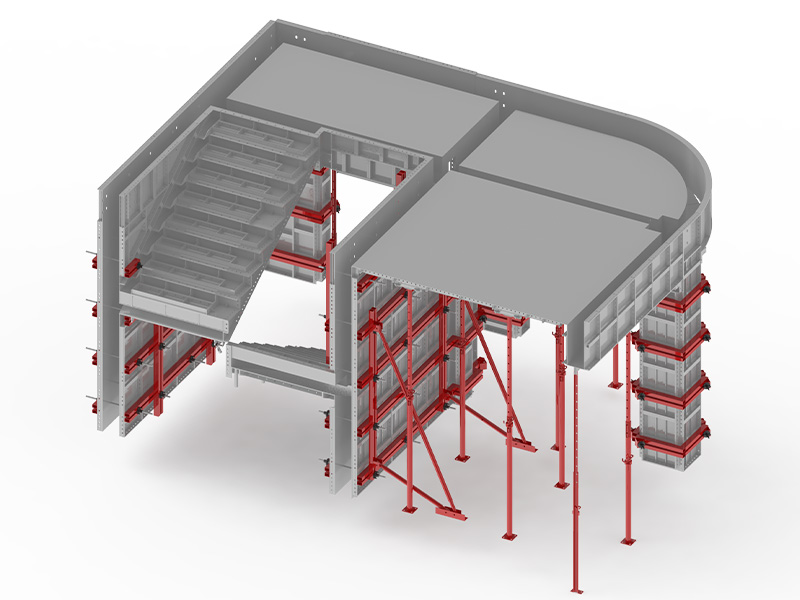
Instead of being dismantled and reassembled at each level, this type of formwork stays attached to the completed portion of the wall or core. Hydraulic jacks push the entire assembly upward after the concrete has gained enough strength, so the forms, working platforms, and reinforcement guides all move together as a unit.
The cycle usually begins with releasing the form panels from the hardened concrete. Rails or climbing shoes anchored into the previous pour provide the track, and the jacks lift the rig to the next casting position. Once it is locked into place and realigned, the crew can set rebar and place the next lift of concrete without waiting for a crane.
On tall cores and shafts, this self-contained movement removes a lot of crane demand and keeps workers on a stable, guard-railed platform at the leading edge of the structure. The system's pace tends to match the floor-to-floor rhythm closely, which makes it a practical choice when vertical construction dominates the schedule.
Tunnel Forms Pour Walls and Slabs in One Go
Contractors who have wrestled with conventional forming know the real cost is rarely the formwork itself—it's the stop-start rhythm of pouring walls, then waiting, then returning to pour slabs days later. Tunnel forms collapse that schedule. These room-sized steel assemblies let you cast load-bearing walls and the ceiling slab as a single monolithic unit, striking the forms and moving them the same day the concrete reaches handling strength.
On site, the setup reads almost too simple: a steel tunnel is wheeled into place, aligned, and locked. Services and reinforcing are set beforehand, so once the concrete truck arrives, the pour is continuous. A 24-hour cycle is entirely realistic for repetitive layouts like hotels, apartments, and barracks. Because walls and slab cure together, you get fewer cold joints, tighter dimensional control, and a structure that behaves as one solid shell rather than a patchwork of separate placements.
What catches first-time users off guard is how quickly the system dictates the build sequence. Door and window openings need to be blocked out with full-depth bucks, electrical conduits embedded in the forms, and slab penetrations planned before the pour—there is no sympathetic patching later. But for the right footprint, the payoff is a leap in productivity that conventional methods simply cannot match.
Aluminum Formwork That Won't Weigh Down the Job
Traditional steel formwork often turns every lift into a logistical headache, demanding extra crew hands and slowing down the pour cycle. But when you switch to a well-designed aluminum system, that burden disappears. The panels feel almost effortless to maneuver, yet they still hold tight tolerances under full hydrostatic pressure. Crews can set and strip entire wall sections without waiting on a crane, which means fewer bottlenecks and a noticeably faster rhythm on the deck.
What really stands out is how this lightweight approach changes the way teams plan their day. Instead of reserving heavy equipment for small adjustments, workers simply carry a panel, reposition it, and lock it into place. The reduced dead weight also eases strain on the supporting structure, so you can push ahead with multiple floors without over-engineering the shoring. It’s a quiet efficiency gain that shows up in the schedule rather than in the spec sheet.
Field reports from high-rise residential and commercial jobs point to the same pattern: fewer back injuries, less downtime for crane coordination, and concrete finishes that need minimal patching. Because the aluminum doesn’t rust and resists concrete adhesion, the forms clean up quickly at the end of each cycle. That means the next pour starts from a better surface, and your investment keeps working instead of sitting in the yard waiting for repairs.
Insulated Concrete Forms Skip the Stripping Step
Traditional concrete walls demand patience: after the pour, you wait for the forms to release, then peel them away panel by panel, clean the residue, and hope the surface is smooth enough to accept insulation. Insulated concrete forms, by contrast, are designed to stay in place permanently. The foam panels become part of the wall assembly, acting as both pour form and continuous insulation layer. There is no stripping crew, no form oil, no pile of plywood to haul off site. The step simply does not exist.
This changes the rhythm of a build. Crews can pour one level and move immediately to the next task while the concrete cures inside its protective shell. The foam also shields the curing concrete from rapid temperature swings, which reduces the chance of early-age cracking. Because the forms remain, there is no need to schedule a return trip for removal or to store bulky formwork between jobs. The labor hours typically eaten by stripping, scraping, and form maintenance are redirected to layout, bracing, or utility rough-ins.
The trade-off is upfront planning. Electrical chases and window bucks must be set before the pour, and braces need to resist the wet concrete pressure. But once the wall is cast, it is already insulated, already aligned, and ready for finishes on both sides. For builders tired of wrestling with form release agents and crowbars, skipping the stripping step is not a minor convenience—it is a quieter, faster way to close in a structure.
Plastic Panels Built for Reuse Across Similar Layouts
The whole point of these plastic panels is that they're made to be taken down, moved, and put back up in a layout that's nearly identical to the last one. There's no need to trim edges or drill new holes just because you're setting up in a slightly different spot. The panels keep their shape, so what worked in one location will work in the next without any guesswork.
That repeatability comes from a few deliberate choices: standardized sizes, pre-cut slots, and a rigid yet lightweight plastic that doesn't warp after repeated handling. You can stack them, lean them against a wall, or pack them flat, and they'll still line up perfectly when you pull them out again. No swelling from moisture, no splintering, no faded edges that give away how many times they've been moved.
For anyone running a retail display, a trade show booth, or a modular workshop, this kind of panel cuts down on both cost and clutter. Instead of ordering new materials for every layout tweak, you reuse what's already there. It's less about being eco-friendly for its own sake and more about simply not wasting money on things you shouldn't have to buy twice.
FAQ
You'll typically see timber, engineered wood, steel, aluminum, and plastic-based systems on job sites. Timber remains popular for small or irregular shapes because it's easy to cut and adapt. Steel and aluminum dominate mid- to high-rise work thanks to their strength and reuse potential. Plastic and fiberglass panels are gaining ground in projects that need lightweight, non-absorbent surfaces.
Aluminum panels are light enough to be handled by one or two workers, which speeds up assembly and striking. Their precise factory dimensions mean fewer on-site adjustments and faster cycle times per floor. Because they can be reused hundreds of times without warping, crews spend less time repairing or replacing panels, and the smooth finish often eliminates the need for plastering.
The main things are the concrete pour pressure, the required surface finish, the number of reuses, and the shape complexity of the structure. You also need to weigh labor availability and crane capacity. A system that looks cheap per square meter might be a bad choice if it demands skilled labor you don't have or takes too long to strip and reset.
Modular systems use standardized panels and connectors that snap or pin together, so workers don't have to measure and cut on site. Repetition becomes the biggest advantage: once the crew learns the assembly sequence, each cycle gets faster. There's also less waste and fewer lost small parts compared to traditional timber, which means fewer trips to fetch materials and less downtime.
The form face is what gives concrete its final texture and appearance. If the form is rough, warped, or leaking, the concrete will show those defects. Using clean, rigid panels with tight joints prevents honeycombing and color variations. Some projects use specially coated or lined formwork to produce architectural finishes directly from the mold, avoiding secondary work like patching or painting.
Yes, steel-framed plywood panels are a solid middle ground. They cost more than bare timber but less than full aluminum, and they hold up well for 30 to 50 reuses if handled carefully. For very high repetition, aluminum pays off despite the upfront price. Plastic-faced plywood is another option for smaller builders who want a smooth finish without investing in metal systems.
Most failures come from underestimating the lateral pressure of wet concrete or from weak connections between panels. The key is to calculate pour rates carefully and not rush the placement. Bracing and ties must be checked against the expected load, not just the static weight. Regular inspection before each pour, especially after stripping and re-erection, catches loose pins, bent frames, and damaged plywood before they become dangerous.
Conclusion
On tight schedules, modular formwork remains a quiet workhorse. A crew of three or four can handle lightweight panels without a crane, snapping them into place and stripping them hours after the pour. That speed comes from repetition—the same frame, the same pins, the same routine—so small teams stay productive instead of waiting on heavy equipment. Aluminum systems push this further: they are stiff enough to hold a clean wall line yet light enough to hand-carry across a floor deck, which keeps fatigue low and setup time short. For projects where the same layout repeats, plastic panels earn their place by surviving dozens of uses without rust or bent edges, and they clean up with just a hose. None of these systems force you to choose between speed and finish quality; the best concrete jobs come from formwork that disappears into the background until the moment you pull it away.
When the structure rises floor by floor, climbing formwork changes the entire pace. Crews reposition the entire wall face with hydraulic jacks instead of dismantling and rebuilding, so the formwork literally follows the building upward. That cuts crane time and keeps the vertical cycle tight. For repetitive cellular layouts—hotels, dormitories, multi-unit housing—tunnel forms pour walls and slabs in one continuous operation, eliminating cold joints and freeing the finishing trades to move in sooner. Where stripping is a bottleneck, insulated concrete forms remove that step completely: the panels stay in place as permanent insulation, and the crew moves on to the next lift immediately. Each system works best when it matches the rhythm of the job—choose wrong, and you fight the formwork; choose right, and concrete construction settles into a rhythm that feels almost automatic.
Contact Us
Contact Person: Quanhui Nian
Email: [email protected]
Tel/WhatsApp: 8618070545691
Website: https://www.getoglobal.com/